EU Close Digest - 10 Nov 2026
AI-generated close market digest from curated financial newsflow.
Hot US CPI at 0.4% headline and 0.3% core drives 50bps December Fed hike bets, S&P 500 down 0.7%.
US Session Open & European Close
US equities opened sharply lower after the October CPI print exceeded forecasts on both headline and core measures, with the S&P 500 trading at 7,498 (-0.69%) and the Nasdaq 100 at 27,655 (-0.91%) two hours into the New York session. The VIX climbed 4.12% to 20.74, reflecting a rapid repricing of terminal rate expectations after Federal Reserve Governor Waller stated a 50 basis point December hike is warranted if core CPI runs at 0.3% month-over-month or higher — a threshold the data met. European markets had closed in positive territory before the US release, with the Euro Stoxx 50 up 0.76% at 6,338, the DAX gaining 0.47% to 26,392, and the FTSE 100 flat at 10,775, as traders there digested ECB Governing Council member Nagel's comment that a December rate increase is "rather obvious." The dollar index strengthened 0.72% intraday to 102.38 while Brent crude slipped 0.66% to $91.96 after President Trump pulled back from threats to strike Iran, removing a geopolitical risk premium that had supported energy prices last week.
Analyst Consensus
- US Inflation & Fed Policy: The October CPI report — headline +0.4% m/m, core +0.3% m/m versus consensus of 0.3% and 0.2% respectively — has cemented a December rate hike and reopened the debate over its magnitude. CNBC, Bloomberg, and InvestingLive all note Waller's explicit framing: 25bps if inflation improves, 50bps if core holds at or above 0.3%, with market-implied hike probability now at 99%. The supercore reading (services ex-housing) at roughly +0.4% and owners' equivalent rent at +0.3% signal persistent shelter and wage-driven pressures. Bloomberg Economics characterizes the core advance as "firm" and says it keeps the Fed on track for a hike next month, while the Financial Times highlights that data-collection gaps from last year's government shutdown distort the print and raise revision risk. The implication is a higher-for-longer rate path that pressures duration, rate-sensitive equities, and housing.
- ECB Hawkish Turn: While the Fed debates hike size, the ECB is signaling a more unified tightening bias. Bloomberg Economics reports Governing Council member Nagel calling a December rate increase "rather obvious" and linking it to a need to "actively constrain the economy." This contrasts with the Fed's data-dependent deliberation and suggests the euro-area deposit rate path will steepen relative to US expectations. The ECB's Cipollone separately outlined the digital euro framework, but the policy signal from Nagel dominates: European rates are moving higher in December regardless of the Fed's final decision, supporting EUR/USD upside if the Fed opts for 25bps over 50bps.
- AI Valuation Extreme: Anthropic's planned IPO — targeting a $1.4 trillion valuation and $64 billion raise at a $70-78 price range for a November 19 debut — sets an unprecedented benchmark for generative AI monetization. Goldman Sachs forecasts revenue of $600-685 billion by 2030, a 130-fold increase from current levels, with cash-flow positivity expected by decade-end. The Financial Times and Bloomberg both cite the Goldman estimates, while CNBC confirms the IPO timeline. The scale tests institutional absorption capacity; any pricing shortfall or weak aftermarket would signal broader fatigue toward AI-linked equity risk and could trigger sector-wide re-rating.
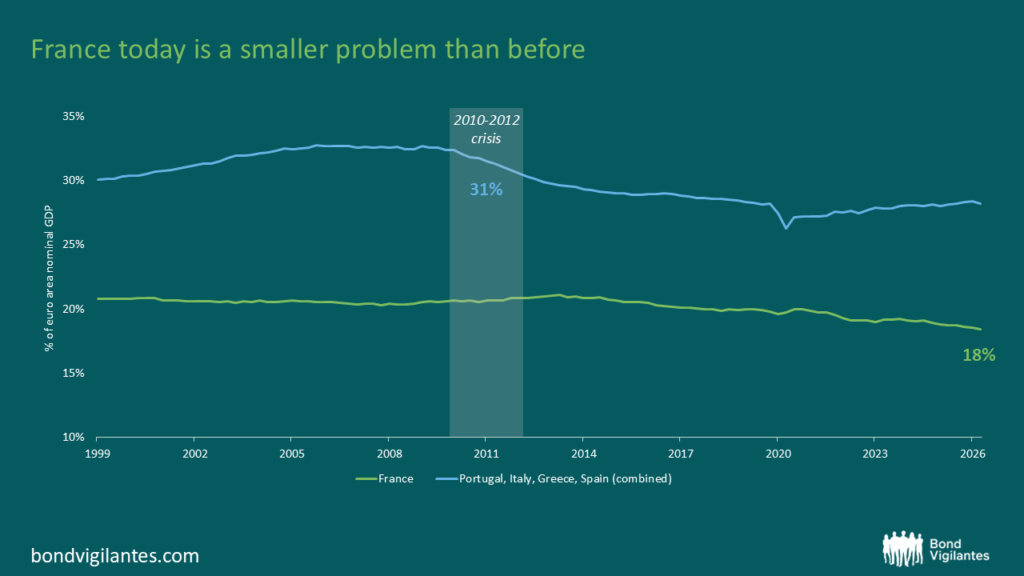
- Geopolitical & Fiscal Risk Cluster: Multiple sovereign stress signals emerged simultaneously. Oil's drop below $90 on US-Iran de-escalation (FT) eases inflation impulses but removes a prop for energy equities. France's budget only narrows the deficit from 5.4% to 5.0% of GDP on growth assumptions its own fiscal watchdog calls optimistic; Bond Vigilantes cites Fitch warning of a "rather painful solution" and flags a potential French restructuring of government securities (FROGS) ahead of the 2027 election. Russia's budget deficit widened to 5.23 trillion rubles ($63 billion) in the first ten months of 2026 (Bloomberg Economics), and China's goods surplus topped $1 trillion for a second year (CNBC), inviting tariff escalation. Italian banks face a €7 billion tax raid over three years (FT), threatening lending capacity.
- Emerging Market Currency & Commodity Pressure: The Brazilian real weakened toward post-election lows after central bank minutes were read as dovish despite rising inflation (Bloomberg Markets). South Africa's commodity price index fell 0.5% in October, the first monthly decline since July (SARB), pressuring exporter revenue. The macro regime monitor flags Turkey, Argentina, UAE, South Africa, and Brazil with internally divergent macro dimensions — restrictive monetary stance alongside weak growth — creating a fragile backdrop for EM debt (EMB -0.62%) and local currency exposure.
Next Session Setup
The Asia-Pacific session will digest Japan's 30-year JGB auction results from November 10 and provisional trade statistics for the first 20 days of October, while China's full-month trade data looms as a gauge of whether the $1 trillion surplus trajectory persists. In the US, the focus shifts to Fed speaker commentary — particularly whether any officials push back on Waller's 50bps framing — and the November 12 Treasury 26-week bill auction ($82 billion) alongside the November 9 3-year note reopening ($58 billion), which together create a concentrated $140+ billion supply week. Key technical levels: S&P 500 7,500 intraday support, DXY 102.50 resistance, Brent $90 psychological floor, and the 10-year yield approaching 4.90% (Nov 9 close 4.88%). Earnings today include SoftBank, Petrobras, Infineon, Honda, Vodafone, and Henkel; Thursday brings Cisco, Applied Materials, Siemens, Allianz, and Enel. The open question: will core CPI stickiness in shelter and services force the FOMC into a 50bps move, or will incoming data before the December 16-17 meeting allow a reversion to 25bps?
