EU Midday Digest - 03 Nov 2026
AI-generated midday market digest from curated financial newsflow.
RBA lifts cash rate to 4.85% in 6-3 split vote, sees inflation above 3% until late 2027 as US midterms and Iran strikes roil risk assets.
Asia-Pacific & European Session
The RBA's 25bp hike to an 18-year high of 4.85% dominated the Asia-Pacific session, with Governor Bullock's cautious tone and a three-member dissent triggering a 0.3% drop in AUD/USD to 0.6975. The Nikkei 225 closed -0.33% at 63,082 while the Hang Seng gained +0.57% to 23,526, reflecting divergent regional sentiment. European markets opened lower with the Euro Stoxx 50 at 6,144 (-0.51%), FTSE 100 at 10,693 (-0.64%) and DAX at 25,812 (-0.65%) as Apple's margin warning sparked a tech rout. Brent crude steadied at $106.41 (+1.57%) after US strikes on Iran's Qeshm Island, while gold slipped to $3,914 (-1.41%) and the dollar index edged up to 101.88.
Key Themes
- RBA: The Reserve Bank of Australia raised the cash rate to 4.85% — its highest since the 2008 financial crisis — in a split 6-3 decision that underscores a divided board. Governor Bullock emphasized data dependence, stating it is "not as obvious" if further hikes are needed, while the RBA's updated forecasts show inflation remaining above 3% until late 2027 and unemployment rising to 5.1% by 2028. The NAIRU estimate was revised to 4.75%. Markets had priced approximately 35bps of additional tightening by mid-2027; the dissent and non-committal guidance now tilt expectations toward a hike-and-hold scenario. Rate-sensitive sectors — banks, consumer discretionary, and real estate — face headwinds, while energy names remain supported by higher oil prices. Attribution: InvestingLive, RBA Media Releases, CNBC Economy.
- US Midterms: US stock futures drifted without direction as investors remained cautious ahead of midterm elections, with voting underway keeping traders from adding risk. The S&P 500 closed at 7,541 (-0.51%) and Nasdaq 100 at 27,990 (-1.39%) on November 2, reflecting pre-election risk aversion. Prediction-market activity is surging as bets on outcomes climb, indicating participants are increasingly pricing political uncertainty. Former White House communications director Anthony Scaramucci told CNBC that Trump faces a "trouncing" and the GOP a "civil war," signaling heightened legislative gridlock probability and reduced fiscal stimulus odds for tax extension and deregulation agendas. Attribution: Investing.com, Bloomberg Markets, CNBC Markets.
- Iran Oil: Oil prices rose early Tuesday after US strikes on Iran's Qeshm Island, with the two sides still far from a breakthrough to reopen the Strait of Hormuz. Brent stabilized at $106.41 after sharp declines, while gold fell to $3,914 as the lack of US-Iran deal progress weakened the traditional safe-haven bid. A senior Iranian official told Reuters that reopening the strait requires the US to meet Tehran's conditions first, with nuclear negotiations only after, maintaining the diplomatic stalemate. Iran signaled it is prepared to respond forcefully, underpinning recent volatility. Jeff Currie, a closely followed oil strategist, said it is time to cash in on crude gains but the structural supercycle remains intact. Attribution: Bloomberg Markets, CNBC Markets, InvestingLive News, Financial Times Markets.
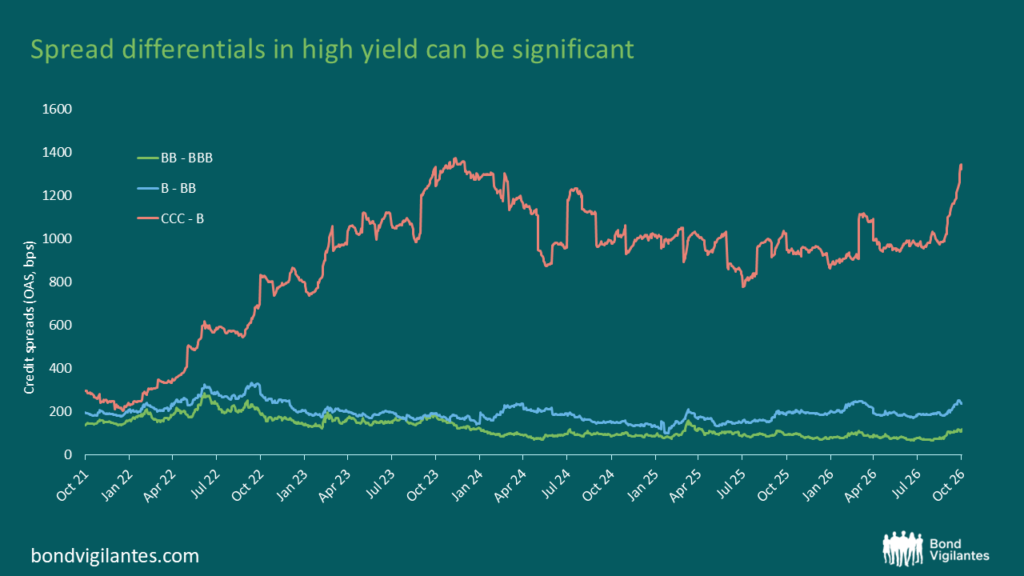
- Credit Gap Risk: Bond Vigilantes argues that "gap risk" now eclipses traditional default risk in high yield, with bonds capable of losing 30+ points (e.g., from 98 to 65) before any default occurs. Bloomberg Gov-OAS indices show BB-B spreads widening while BBB-BB stays flat, confirming lower-tier pricing is discontinuous rather than incremental. A liquidity vacuum emerges around 85% of par where traditional investors sell but distressed buyers only step in significantly lower, citing VMED 5⅝ 04/15/32, Aston Martin, BCP V Modular Services and Intrum 8½ 09/11/30 as recent examples. Recovery modeling must incorporate a "second gap" from creditor-on-creditor violence via liability-management exercises. Rising spread dispersion revives active security selection value over index-based strategies. Attribution: Bond Vigilantes.
- Treasury Supply: The Treasury is front-loading $177 billion of bill supply into a single auction cycle — 13-week ($95bn) and 26-week ($82bn) both settling November 5 — exceeding the $165bn combined offering from the prior October cycle. The 13-week continues to dominate the 26-week by $13bn, reinforcing Treasury's preference for ultra-short funding despite yield curve inversion. Both new CUSIPs (912797VV6 and 912797WX1) confirm no reopenings, eliminating fungibility and forcing primary dealers to underwrite fresh paper each week, increasing balance sheet charges under SLR constraints. Maturities on February 4 and May 6, 2027 lock in funding through the projected first half of the Fed easing cycle. The announcement-to-auction window compressed to just four calendar days, coinciding with month-end rebalancing and the November 1 nonfarm payrolls release, creating a liquidity vacuum. Attribution: TreasuryDirect.
13F Filings
Sanders Capital (US$103bn, 46 positions) filed its 2026Q3 13F since November 2, bringing the total to 6 of 115 tracked funds that have reported. Holdings are as of quarter end, not current positions. Cross-fund agreement shows net buying in DIS (1 new, 1 added), APH (1 new, 1 added), TJX (1 new, 1 added), and AMZN (0 new, 3 added). Net selling concentrated in V (0 exits, 3 trims), AMAT (1 exit, 2 trims), BAC (0 exits, 3 trims), and GEV (1 exit, 2 trims). These filings reflect portfolio decisions made months ago and should not be interpreted as current trading signals.
What to Watch
Today's earnings slate includes AMD, AMGN, ANET, SHOP, PFE, ETN, MPC, BKNG, ISP, SU, ITUB, and APO — all reporting either before or after the US close. Apple (AAPL) and Palantir (PLTR) already reported Monday after the close, with AAPL shares falling 4.5% premarket on margin disappointment and PLTR slumping 8% on commercial scaling skepticism. The US midterm election results will be the dominant catalyst, with Polymarket showing Republican win probability at 95% for NC-10 House seat and Democratic win at 79% for NY-01. Watch Brent crude above/below $106 for Iran escalation signals, AUD/USD support at 0.6900-15 with June lows at 0.6865-75 as downside target, and the Treasury 13-week/26-week auction results for tail width and bid-to-cover ratios. The Riksbank is expected to deliver its first rate increase since 2023 this week per Bloomberg Economics. Eurogroup calls for ECB presidency nominations by November 6. Key open question: Will the RBA's divided board and hike-and-hold pivot become the template for other central banks facing sticky core inflation but weakening growth?
