EU Close Digest - 27 Oct 2026
AI-generated close market digest from curated financial newsflow.
Nasdaq 100 surges 1.24% to 29,637 as Anthropic IPO filing reignites AI trade while Brent crude falls 1.12% to US$ 109.50 ahead of Fed hold decision.
US Session Open & European Close
US equities opened higher with the S&P 500 trading at 7,717 (+0.52%) and the Nasdaq 100 at 29,637 (+1.24%), led by mega-cap technology as Anthropic's IPO filing and Meta's US$ 95bn capital raise catalyzed a revival of the AI investment theme. European markets closed mixed: the Euro Stoxx 50 finished at 6,168 (+0.85%) and the DAX at 25,607 (+0.77%), while the FTSE 100 lagged at 10,689 (-0.72%). The US session confirmed the European morning's tech-led bias but diverged on energy, where Brent slipped 1.12% intraday even as INSEE reported violent euro-term energy inflation re-acceleration in September (petroleum +16.5% MoM, natural gas +21.2% MoM). Breadth favored growth over value, with the VIX declining 4.57% to 17.55, while the dollar index firmed to 102.26 (+0.30%) and gold advanced 0.87% to US$ 4,073.
Analyst Consensus
- AI Infrastructure Supercycle: The convergence of Anthropic's IPO filing, Meta's US$ 95bn equity raise backed by Nvidia and AMD investing a combined US$ 4bn, and Dell's positioning as a full-stack AI infrastructure provider signals an intensifying capital expenditure cycle. Bloomberg notes the rally was driven by technology companies valued at more than US$ 10tn positioning ahead of earnings and the Fed decision. The Financial Times highlights a Hotelling effect in AI fundraising where rivals cluster large capital raises. This magnitude of coordinated capex reinforces semiconductor equipment, memory, and networking demand, though return-on-invested-capital timelines remain uncertain.
- Fed Policy Trajectory: The CNBC Fed Survey shows 93% of respondents expect a hold this week, aligning with InvestingLive's 90% market probability, but Stifel's Lindsey Piegza argues returning inflation to 2% would require "more than two rate hikes" while believing the Fed will probably hold at 5.25-5.50%. Bloomberg reports the Conference Board's October consumer confidence rose to 91.7 from 101.5, driven by brighter job market views, which could temper tightening expectations. The divergence centers on whether the "hawkish hold" language from Chair Warsh signals future tightening bias or merely maintains optionality.
- Eurozone Inflation/ECB Dilemma: INSEE data reveals a structural shift in energy inflation with synchronized petroleum and gas surges suggesting supply-side tightening, while industrial commodities remain +20.5% YoY despite monthly deceleration. Simultaneously, the ECB's October bank lending survey shows net 9% tightening of corporate credit standards and 14% for consumer credit, with housing loan demand slumping 27%. InvestingLive notes traders price 90% odds of no November change but 70% odds of a 25bp December hike. French consumer confidence collapsed to 80 (lowest since June 2013) while precautionary saving intentions stay elevated at 118, creating a stagflationary impulse that limits ECB maneuverability.
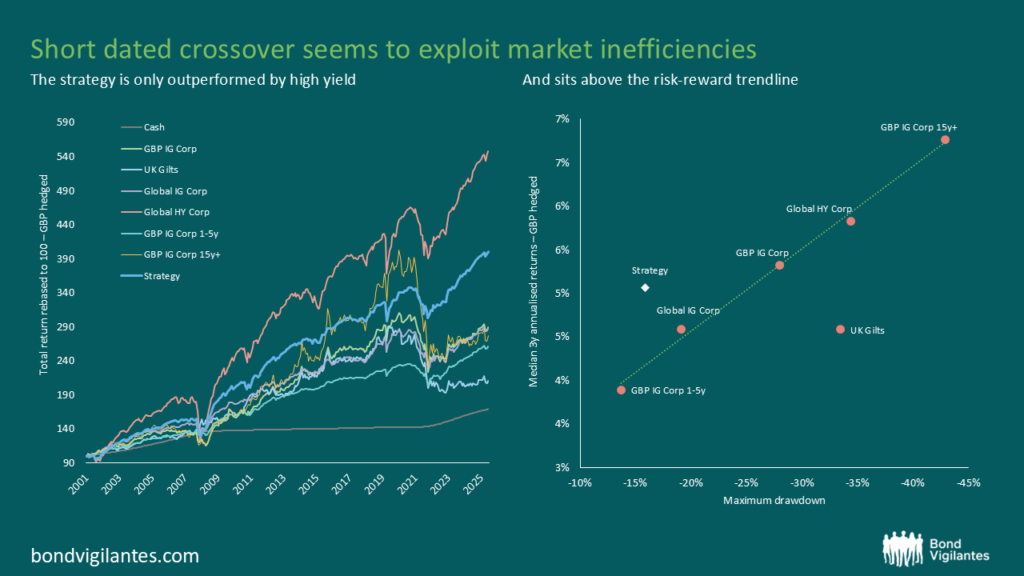
- Credit Market Stress Peak: Galaxy Digital's Michael Novogratz argues anxiety in global credit markets over AI spending is reaching "peak nervousness" and on the verge of easing, which could compress spreads and improve funding conditions for AI infrastructure. Bond Vigilantes' analysis of a 50/50 short-dated BBB/BB crossover strategy shows historical maximum drawdown of 17% (during GFC) with rolldown income and crossover inefficiencies at the IG/HY border providing structural support. Fallen angels research indicates bonds downgraded from IG to HY tend to outperform both categories longer-term, supporting the thesis of avoiding excessive duration risk and deep HY credit risk.
- Geopolitical Trade Escalation: Iran has threatened South Korean shipping group Sinokor over alleged Strait of Hormuz violations, marking enforcement escalation that previously involved military action. Simultaneously, President Trump threatened to raise Canadian auto tariffs from 25% to 50%, with Honda warning this would be "catastrophic" for the integrated North American production system where parts cross borders multiple times. Japan imposed definitive anti-dumping duties on nickel-added stainless steel from China and Taiwan. These developments create asymmetric risk for automakers with Canadian exposure (Honda, Ford, GM, Stellantis) and energy transit routes, while reinforcing friend-shoring dynamics in critical minerals.
Tomorrow's Setup
Asian overnight session shows Nikkei 225 at 63,268 (+1.73%) and Hang Seng at 23,041 (-0.73%), setting a mixed tone. The FOMC decision Wednesday is the pivotal catalyst: markets price a hold but will scrutinize statement language for "hawkish hold" signals per InvestingLive. The BoJ meets for two days, expected to hold at 1.25% but signal December hike readiness after services PPI accelerated to 3.7% YoY. Mega-cap earnings cascade begins with Microsoft, Alphabet (both classes), and Samsung Electronics Wednesday, followed by Amazon, Eli Lilly, Mastercard, Intel, and Merck Thursday, then Exxon, Chevron, and AbbVie Friday. Key levels to watch: S&P 500 7,717, Nasdaq 100 29,637, US 10Y at 5.00%, DXY 102.26, Brent US$ 109.50, gold US$ 4,073. The open question: whether Microsoft, Alphabet, and Amazon earnings justify current AI infrastructure valuations or trigger a reassessment of the capex intensity versus monetization timeline.
