EU Close Digest - 14 Oct 2026
AI-generated close market digest from curated financial newsflow.
Hot US CPI at 3.7% YoY drives Fed hike odds to 47% as Brent holds $105 on Iran war risk.
US Session Open & European Close
US equities opened sharply lower with the S&P 500 trading at 7,734 (-0.92%) and the Nasdaq 100 at 30,113 (-1.49%) as the September CPI print of 3.7% YoY — above the 3.6% consensus — lifted the October Fed hike probability from 21% to 47% with 36bps of tightening now priced for the year. European markets had closed mixed earlier, the Euro Stoxx 50 finishing at 6,196 (+0.46%) and the FTSE 100 at 10,730 (+0.75%) after trimming gains as WTI rose 1.38% to $95.45 on reports of a container ship sunk in the Strait of Hormuz. The Dollar Index surged to 102.88 (+0.69%), near overbought territory per Investing.com, while the 10-year Treasury yield climbed to 5.25% (+3.2bp intraday). Gold fell 1.52% to $4,114 and Bitcoin dropped 1.59% to $81,776 as hotter inflation pressured risk assets. Sector rotation was evident with the SPDR Aerospace & Defense ETF (XAR) seeing a $133.7m weekly outflow and the Fidelity Utilities ETF (FUTY) recording a $156.8m outflow (7% WoW), signaling a retreat from defensives.
Analyst Consensus
- US Inflation & Fed Policy: The September CPI surprised to the upside at 3.7% YoY (unrounded +3.738% vs +3.397% prior) with core at 2.6% YoY (+2.564% unrounded vs +2.446% prior) and core MoM +0.33% vs +0.2% expected, reinforcing inflation persistence per InvestingLive. Key subcomponents broadened: owners' equivalent rent +0.3%, motor vehicle insurance +0.1%, used cars +0.7%, energy +5.2% (gasoline +9.1%), while supercore services ex-housing rose to +3.13% YoY from +3.022%. Real weekly earnings fell -0.5% vs +0.2% prior, highlighting consumer purchasing power erosion. Both Bloomberg Economics and InvestingLive note this keeps the Fed on a higher-for-longer path, with JPMorgan's David Kelly arguing the October meeting (six days before the election) makes a hike unlikely, creating a tension between data-driven pricing and political timing.
- Middle East Energy Shock: Escalating conflict is transmitting directly into energy costs. Destatis attributes Germany's wholesale price surge of +8.7% YoY to the Iran war pushing up energy and metals, while the IEA warns global diesel shortages will persist until mid-2027. CNBC reports Iran "counting the moments" to attack US warships and Houthis striking Saudi Aramco headquarters, with a container ship sunk in the Strait of Hormuz. Bloomberg notes Lagarde flagged energy as the ECB's key transmission channel — a further oil/gas jump from Gulf escalation raises pre-emptive tightening odds. This contrasts with Goldman Sachs' RBA view that Middle East conflict pushing oil higher is an upside risk that could prompt earlier hikes, creating a cross-central-bank sensitivity to the same geopolitical driver.
- Bank Earnings & Regulatory Overhang: Bank of America shares fell 8% after a 17% profit drop driven by a $1.2bn money-laundering fine and weaker trading revenue than peers per MarketWatch and FT. RBC's Gerard Cassidy notes the settlement was largely priced in, but warns rising rates could pressure margins via net interest income compression, while AI investment, credit risks, and State Street's selloff are forcing sector-wide reassessment. BlackRock's $205bn inflows pushing AUM to a record $15.5tn (half US GDP) underscores concentration in large managers, yet financial sector sentiment is weighed by regulatory-cost risk. The pairing of a quantified penalty with a core revenue miss creates a double hit to earnings quality that Bloomberg says may not shock capital but raises questions about the regulatory burden on large banks.
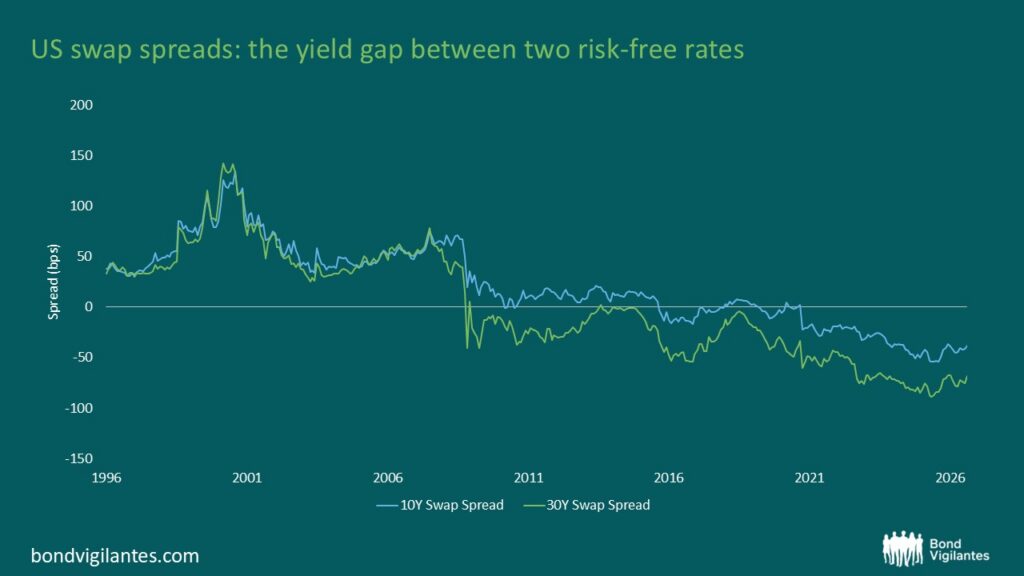
- Swap Spread Arbitrage in Credit: Bond Vigilantes highlights a structural opportunity: negative swap spreads (10Y ≈ -40bps, 30Y ≈ -70bps) mean US investment-grade credit trades ~150bps over swaps vs ~90bps over Treasuries. Hedging dollar duration with swaps instead of Treasury futures captures an extra 40-70bps for the same credit risk. In August the firm rotated part of its futures hedge to swaps, moving a dollar-denominated Google bond to ~170bps over swaps — more attractive than the euro counterpart at ~110bps — allowing a switch from euro to dollar bonds for higher spread without added credit risk. The trade carries swap-spread risk: if Treasuries sell off while swaps stay flat, the hedge fails. The position bets on normalization toward zero rather than further widening.
- ECB Pre-emptive Bias & French Fiscal Risk: Lagarde stated the ECB will act on early hints of second-round effects rather than wait for clear evidence, monitoring wage expectations in collective bargaining as an early warning. Euro area growth of 1.1% in 2026 was described as "not brilliant but not bad." Goldman Sachs notes the French-German yield spread has widened sharply amid political tensions over the French budget, a divergence expected to persist ahead of the French presidential election in H1 2027. Lagarde offered no ECB backstop for French debt, leaving the spread exposed to Paris's budget politics. This creates relative-value risks for euro-area sovereign investors as fiscal credibility becomes the primary driver of peripheral spreads.
Tomorrow's Setup
Asia opens with the Nikkei at 67,744 (-0.05%) and Hang Seng at 24,314 (-0.13%) as markets digest the CPI-driven repricing. Key catalysts: US PPI and retail sales (both due tomorrow) will either reinforce or weaken the 47% October hike probability per InvestingLive; the RBA's Q3 CPI on 28 October (00:30 GMT) is the pivot for a potential November hike per Goldman Sachs; TSMC, Charles Schwab, Interactive Brokers, Prologis, BNY Mellon, US Bancorp, PNC, Marsh & McLennan, and Nordea report earnings Thursday. The 10-year Treasury at 5.25% and DXY at 102.88 are near-term resistance levels; a break above 5.30%/103.00 would signal sustained hawkish momentum. Brent at $105.81 and WTI at $95.45 remain bid on Strait of Hormuz risks. The open question: whether tomorrow's PPI/retail sales validate the CPI surprise enough to push October hike odds above 50%, or whether the Fed's election-period blackout (starting Saturday) caps the repricing regardless of data.
