EU Midday Digest - 12 Oct 2026
AI-generated midday market digest from curated financial newsflow.
Trump's Russia-Ukraine energy ceasefire claim collides with Iran's Hormuz retaliation doctrine as diesel cracks persist.
Overnight & European Session
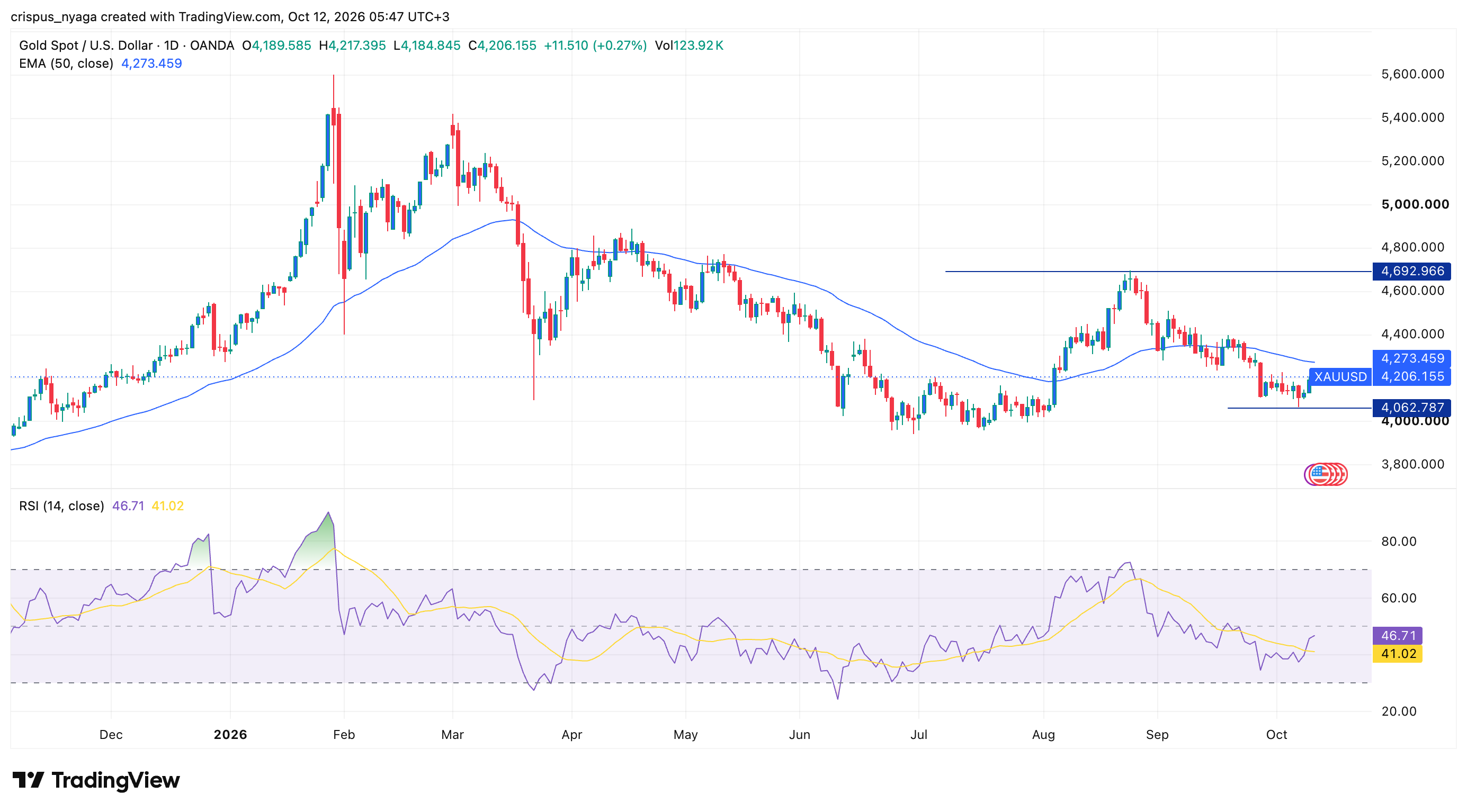
European equities opened higher with the DAX up 0.71% to 25,267, the Euro Stoxx 50 gaining 0.54% to 6,207 and the FTSE 100 rising 0.68% to 10,623, supported by Trump's statement ruling out military action against Iran before the midterms. Brent crude traded at $105.65, up 0.89%, while gold slipped 0.34% to $4,202 as oil-driven inflation fears eased. The dollar index firmed 0.18% to 102.40 with EUR/USD at 1.1184 (-0.26%) and USD/JPY at 158.62 (+0.35%). Asian markets showed divergence: the Hang Seng edged up 0.25% to 24,271 while the Nikkei 225 closed flat at 69,031 on Friday. The VIX climbed 4.31% to 15.48, reflecting lingering geopolitical uncertainty despite the risk-on equity move.
Key Themes Today
- Geopolitics/Energy: Trump declared an immediate "energy ceasefire" between Russia and Ukraine aimed at containing fuel costs ahead of the midterms, but Zelenskyy reported Russian strikes on Kharkiv and Kyiv power plants within hours and the Kremlin has not confirmed the deal. Simultaneously, Iran's security chief Rezaei called the US response to Tehran's Hormuz proposal "insufficient" and warned of attacks on regional cables, data centres and AI facilities, while Saudi Arabia intercepted missiles near oil and gas facilities after Riyadh airport strikes killed 14. The Russian diesel release of 500,000 tonnes is deemed too small and contested to alleviate the global shortage, with IEA chief Birol urging members to accelerate strategic releases. ICYMI Overnight notes the 8.3% drop in European diesel futures likely overstates supply relief, leaving cracks vulnerable to snap-backs.
- Fed Policy Divergence: Fed Governor Adriana Hammack told the WSJ that "rates need to rise beyond 3.75–4%" and dismissed higher Treasury yields as a "complement, not a substitute" for policy moves, signaling continued tightening with smaller, more frequent hikes. This contrasts sharply with a Morgan Stanley strategist cited by MarketWatch who argues the bond market is already tightening financial conditions enough — via a stronger dollar, higher yields and elevated gas prices — that the Fed may not need further hikes, with Kevin Warsh potentially pausing. MUFG expects September headline CPI at 3.6% (core 0.2% m/m) and notes Warsh speaks at the IMF meetings Friday, his first remarks since the September FOMC, with markets parsing his tone for October 27-28 guidance.
- AI Funding Collapse: Morgan Stanley data show global AI-linked bond issuance collapsed to $23bn in September from a June peak of $113bn, with US investment-grade AI bonds vanishing entirely in September after $306bn was raised January-August. Intel and Broadcom CEOs warned that access to capital, not just chips or demand, may become the binding bottleneck for AI expansion. This funding gap coincides with ASML raising prices 10% on all EUV and DUV replacement parts for South Korean customers starting January 2027, with Samsung and SK Hynix already accepting the hikes, compounding yield-maintenance costs across the memory supply chain. The sharp slowdown will likely curb AI project roll-outs and shift capital toward equity or private-market financing.
- China FX & EM Sovereign Risk: The PBOC set the USD/CNY reference rate at 6.7313, notably weaker than the 6.6977 estimate, signaling continued management against rapid appreciation while injecting 50bn yuan via 7-day reverse repos at 1.4%. Goldman Sachs links firmer yuan fixings to the Trump-Xi summit run-up, mirroring historical diplomatic patterns. Meanwhile, the RBI unveiled a dedicated $10bn monthly dollar window for state-run oil refiners to absorb concentrated corporate demand off the spot market, supporting the rupee after it slid toward 97. In sovereign debt, Senegal plans to test the upgraded G-20 Common Framework at the IMF/World Bank meetings in Bangkok, a key precedent for EM restructuring burden-sharing, while Pakistan targets another ratings upgrade to lower risk premiums ahead of planned market access.
- Earnings Season Kickoff: Major US banks report this week with JPMorgan, Goldman Sachs, Morgan Stanley, Bank of America, Citigroup, Wells Fargo and UnitedHealth all due Tuesday, followed by ASML, BlackRock and Charles Schwab Wednesday. European bank gains drove Monday's equity advance per Investing.com, though no index levels or specific names were provided. FB Financial already reported Q3 revenue of $175.9m (+27.5% y/y) but missed expectations, with peers down 7.4% over the past month versus FBK's 4.8% decline, highlighting sector sensitivity to forward guidance.
What to Watch
Wednesday's US CPI is the week's pivotal macro catalyst: consensus expects headline at 3.7% y/y (up from 3.4%) and core at 2.5% (from 2.4%), with MUFG forecasting 3.6% headline and 0.2% m/m core; only an upside surprise would revive an October hike given recent pushback from Williams and Jefferson. Fed speakers today include Hammack (hawkish), Breeden (neutral) and Mann (hawkish) — note the US bond market is closed for a holiday, leaving equities to trade with thin liquidity. The Russia-Ukraine energy ceasefire's durability will be tested by whether Russia confirms the deal and halts infrastructure strikes, while Iran's seven conditions for Hormuz passage remain unresolved with intermediary talks continuing. Earnings focus shifts to Tuesday's bank quartet (JPM, GS, MS, BAC) plus C, WFC and UNH for clues on consumer credit, investment banking and net interest margin trends. Open question: can earnings optimism sustain the S&P 500's approach to all-time highs (7,812 Friday close) if the ceasefire narrative fractures and Iran escalation risk reasserts a crude risk premium?
