EU Midday Digest - 09 Oct 2026
AI-generated midday market digest from curated financial newsflow.
Trump's Iran pledge pulls Brent to $103 as Fed hawks split and AI credit spreads widen
Overnight & European Session
Asian equities traded mixed with the Nikkei 225 flat at 69,031 while the Hang Seng rose 1.79% to 24,211, as Trump's Truth Social post ruling out strikes on Iran before the November midterms unwound the geopolitical risk premium in crude. Brent retreated 1.24% to $102.99 in European morning trade, pulling the dollar off highs with DXY steady at 102.14 and EUR/USD edging up 0.11% to 1.1213. European bourses opened firmer, the Euro Stoxx 50 gaining 0.76% to 6,173 and the DAX up 0.99% to 25,052, as lower energy costs eased input-cost pressure. Gold extended gains to $4,207, up 1.20%, reflecting persistent haven demand despite the oil pullback. The divergence between Asia's cautious tone and Europe's relief rally underscores how quickly the Iran narrative can reshape cross-asset correlations.
Key Themes Today
- Geopolitics & Energy: Trump's declaration that the US will not attack Iran before the midterms triggered an immediate reversal in crude, with Bloomberg reporting the pullback cooled escalation fears that had jeopardized regional energy flows. Brent's drop to $102.99 from recent highs reduces inflationary pressure on oil-importing economies and may give the Fed cover to maintain a patient stance, though Pentagon preparations for a three-day strike campaign remain in place per New York Times reporting. The asymmetry — presidential rhetoric versus military readiness — creates a fragile equilibrium where any shift in tone could reignite the risk premium. Investors should watch for headlines from Tehran or Washington that could snap Brent back above $105.
- Fed Policy Split: St. Louis Fed President Musalem explicitly stated that "more monetary policy firming will be required" to return inflation to target, citing strong economy and business contacts focused on inflation over employment, per InvestingLive. This hawkish lean contrasts with recent patient comments from New York Fed President Williams and Vice Chair Jefferson, highlighting an FOMC split that could sustain upward pressure on front-end rates. The 2-year Treasury yield at 4.77% (stale close) and 10-year at 5.23% reflect this tension; a hawkish resolution would steepen the curve further. Markets now price the next move around the November meeting, with the Michigan consumer survey's inflation expectations (year-ahead at 4.6% in September) as a key input.
- AI Credit Stress: Bloomberg reports the rush to finance AI is shaking the more than $10 trillion US corporate market, prompting a repricing of risk for large technology firms visible in rising credit-insurance premiums, higher volatility and weaker performance. Citi separately notes AI model progress is outpacing data center infrastructure, suggesting capital intensity will remain elevated. The convergence of heavy issuance and tightening financial conditions could widen tech spreads versus investment-grade peers, with LQD at $102.47 (+0.36%) outperforming HYG at $77.14 (-0.05%). Investors should monitor CDS costs for AI-exposed names as a leading indicator of funding stress.
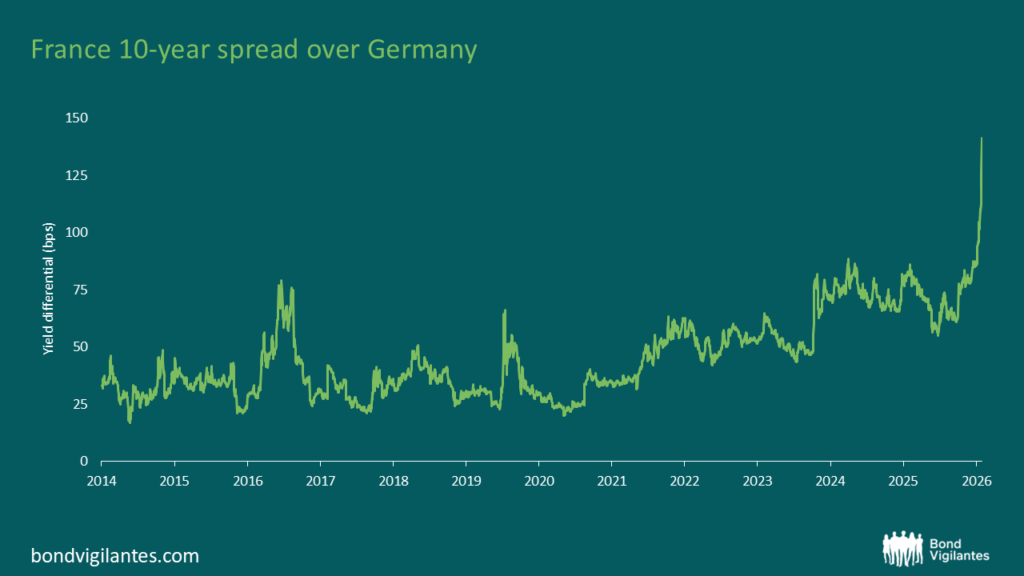
- Eurozone Fiscal Fragility: Bond Vigilantes argues France's 10-year spread at 150bps over Bunds may be misleading, noting Italian spreads exceeded 500bps during the sovereign crisis and that durable ECB support requires credible fiscal adjustment — complicated by France's approaching presidential election and Germany's reduced willingness to underwrite neighbours. The FT's FSB warning that only the US, UK, Japan and Hong Kong have credible public bank backstops compounds the risk: resolution uncertainty in other jurisdictions could widen peripheral spreads further. The piece proposes shorting Spanish 100% debt-to-GDP bonds against duration-matched Bunds as a relatively inexpensive fragmentation hedge. Eurostat's synchronous release of capital formation, balance sheets and value-added data on 9 October provides a fresh lens to track these dynamics.
- Telecom Disruption: CNBC reports SpaceX's acquisition of Grain Management's nationwide 800 MHz spectrum portfolio (up to 14 MHz of paired low-band airwaves) for Starlink Mobile, with FCC approval for 15,000 next-gen direct-to-phone satellites, "hammers shares" of AT&T, Verizon and T-Mobile. The deal signals SpaceX's intent to deepen Starlink's US market presence, potentially eroding traditional wireless revenue streams. Nasdaq CEO Adena Friedman separately noted tokenization could unlock "tens of billions of dollars" of trapped capital, suggesting broader digital-asset infrastructure shifts that may benefit satellite-connectivity plays. Telecom investors must reassess competitive moats as low-earth-orbit broadband moves from niche to direct substitute.
What to Watch
Delta Air Lines (DAL) reports before the US open, offering the first major airline read on post-summer demand and fuel-cost pass-through after the Iran-driven oil swing. The Michigan consumer sentiment survey at 10:00 ET will test whether year-ahead inflation expectations hold at 4.6% or retreat, with a hotter reading likely keeping Treasury yields elevated and supporting the dollar. Canadian jobs data and Italian industrial production are second-tier releases unlikely to move central bank policy per InvestingLive. Key technical levels: Brent holding below $103 could target $100; a break above $105 reignites geopolitical premium. EUR/USD at 1.1213 tests the 1.1250 resistance; a close above opens 1.13. The 10-year Treasury at 5.23% — if it reclaims 5.25%, the AI credit repricing narrative accelerates. Divergence: Musalem's hawkishness versus Williams/Jefferson patience leaves the November FOMC call genuinely open. Open question: Does the Iran de-escalation hold long enough for the Fed to pivot to growth risks, or does the AI credit crunch force tighter financial conditions regardless?
