EU Close Digest - 17 Sep 2026
AI-generated close market digest from curated financial newsflow.
The VIX collapsed 10.56% to 15.84% as the 10-year Treasury yield fell 6.3 bps to 4.94%, the sharpest risk-on rotation in six weeks.
US Session Open & European Close
US equities surged at the open, with the S&P 500 closing at 7,628 (+1.01%) and the Nasdaq 100 at 29,406 (+1.59%), as a sharp decline in the VIX to 15.84% (-10.56%) signaled a rapid unwind of near-term hedging activity. The session confirmed the European morning's risk-on tone—the Euro Stoxx closed at 6,329 (+0.99%)—with both markets driven by falling oil prices (Brent -2.06% to US$ 103.65) and a notable flattening in the US yield curve: the 2-year rose 2.0 bps to 4.67% while the 10-year fell 6.3 bps to 4.94%, a 8.3 bps daily steepening that suggests markets are pricing Fed patience extending beyond October. The Nasdaq's outperformance (+1.59%) over the S&P (+1.01%) reflects rotation into rate-sensitive technology names as long-end yields eased, while the DXY fell 0.14% to 100.17 and EUR/USD rose 0.48% to 1.1482, consistent with reduced safe-haven demand. Gold held firm at US$ 4,402 (+0.33%) and BTC/USD edged up to US$ 76,436 (+0.37%), indicating crypto and precious metals are not yet displacing equities as the primary risk asset.
Analyst Consensus
- Fed patience vs. inflation persistence: The former Atlanta Fed President (per InvestingLive) argues that supply shocks are now lingering and feeding expectations, warning that "inflation expectations are solid until they aren't." He expects the Fed's patience to extend into the October meeting, a view corroborated by Bostic's public comments signaling relief that the Fed is taking inflation risks seriously. The newsletter notes the current hiking cycle is historically modest—the smallest ever cycle was 137 bps—and markets are pricing three more hikes to a 4.50-4.75% terminal rate, which would approach the post-COVID peak of 5.375%. The implication: short-dated yields may stay elevated (2-year at 4.67%) while long-end relief (10-year at 4.94%) reflects growth concerns rather than Fed dovishness. If oil prices spike on Middle East tensions (per BoE's Bailey), the hawkish scenario reasserts.
- Canada's macro divergence: Statistics Canada data reveals a sharp contrast: domestic investors shed $30.6 billion of foreign securities in July (led by US equity sales) while non-residents absorbed $20.7 billion of Canadian government bonds, creating a self-reinforcing CAD-supportive flow. Simultaneously, the labour market shows persistent slack (vacancies unchanged at 510,200 in Q2) while producer price inflation accelerates (Industrial Product Price Index +13.5% YoY, Raw Materials Price Index +22.8% YoY). The Bank of Canada held at 2.25%, projecting confidence in inflation convergence, but the commodity price surge suggests a pass-through lag that could force a policy rethink. Both the Statistics Canada Labour and Prices analyses flag this tension: stagnant hiring alongside accelerating input costs.
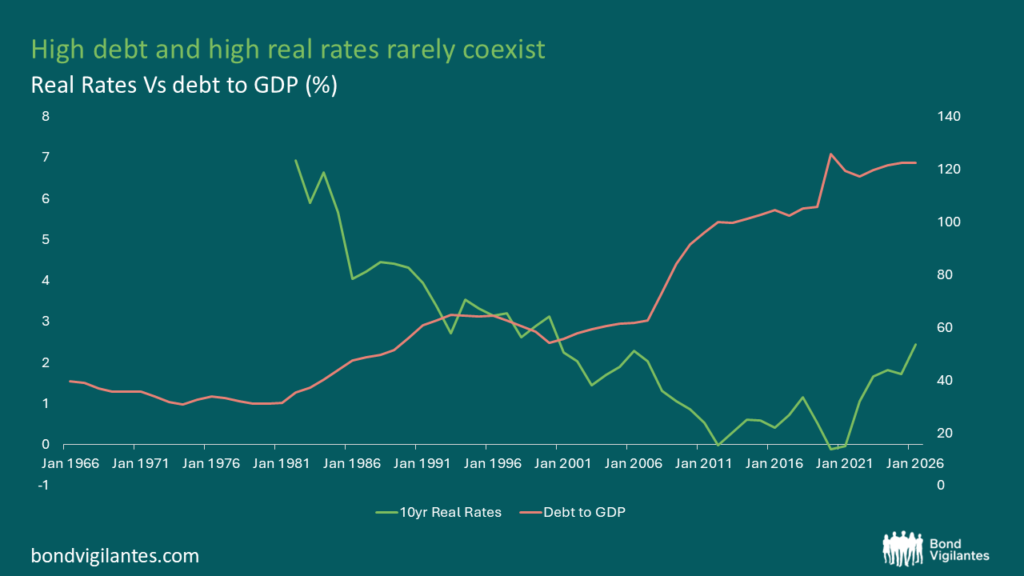
- Financial repression and real assets: Bond Vigilantes argues that rising government debt-servicing costs and structurally high real rates point to financial repression as the most viable fiscal tool for highly indebted governments. The newsletter cites Bloomberg data showing TIPS trading at "the most attractive level in many years" and notes gold and commodities have already moved meaningfully higher. The BIS research paper on DeFi complexity and the SEC's temporary exemptive relief for tokenized securities venues both underscore that regulatory frameworks are struggling to keep pace with structural shifts. The cross-asset implication: nominal bonds face suppressed real returns, favoring inflation-linked securities and real assets over traditional fixed income.
- Earnings breadth vs. positioning risk: Nasdaq-Earnings reports 14 of 16 Zacks sectors producing positive earnings growth in Q3, with six sectors on track for double-digit gains—the widest sector-wide upside in recent history. The macro regime match (AR, BR, IN, SE) suggests this is a structural rather than cyclical driver. However, the Ashenden AFVS signals flagging DINO, DHER.DE, and HUM as deeply undervalued (AFVS 89, premium -28%) while BSX, FIG, and PODD appear overvalued (AFVS 16-17, premium +49-52%) indicates significant dispersion within sectors. The sharpest contrarian call: the BoE's Bailey explicitly rejected the market's pricing of four rate hikes, stating the MPC "did not discuss the prospect of hiking four times"—a direct contradiction of the curve pricing that could trigger a rapid gilt re-pricing if markets test his resolve.
- Treasury supply shock and curve dynamics: TreasuryDirect announced $267 billion of short-dated bill issuance over ten days ($90bn 4-week, $85bn 8-week, $92bn 13-week) alongside a $69bn 2-year note, all hitting the market without anticipated Fed accommodation. The 4-week bill at $90 billion is nearly double the historical norm of $30-50 billion, likely testing cash-management market depth. The Bloomberg Markets analysis (Popenoe, Dynex Capital) attributes 7% mortgage rates primarily to the 10-year Treasury at 4.35%, citing $1.2 trillion in government borrowing over six months and $150 billion in hyperscaler debt issuance competing for capital. The combined supply surge and corporate bond competition create upward pressure on all long-dated yields, though today's 10-year decline suggests the market is currently prioritizing growth concerns over supply fears.
Tomorrow's Setup
Asia faces a mixed session: the Nikkei 225 closed at 63,923 (+0.69%) on September 16, and the USD/JPY at 155.82 (+0.36%) suggests limited safe-haven demand from Japan despite the yen's persistent weakness. The Ashenden macro regime data flags the US at stress level 3.5 (restrictive monetary stance) and the Eurozone at 4.4, with the US showing the highest stress reading among major advanced economies. No specific consensus estimates for tomorrow's macro releases are identified in the source material. The Polymarket data shows markets pricing an 87% probability that Eurozone Q3 GDP growth falls outside the 0.4-0.7% range, and a 59% probability the 30-year Treasury yield dips below 5.20% before 2027—consistent with today's long-end rally. Key risks to monitor: (1) any escalation in Middle East conflict that could push Brent back above $105 and reignite inflation concerns; (2) BOC Deputy Governor appointment process and its signaling on future rate path; (3) RBA's quarterly Statement on Monetary Policy for updated inflation and growth outlooks. The open question the market is most focused on: whether the VIX collapse and 10-year yield decline represent a durable shift in risk appetite or a temporary unwind of hedges ahead of potential October Fed action.
