EU Close Digest - 14 Sep 2026
AI-generated close market digest from curated financial newsflow.
The US 10-year Treasury yield's breach of 5% confirmed a re-pricing of terminal rate expectations, dragging global equities lower and accelerating a rotation out of AI-heavy growth stocks.
US Session Open & European Close
US equities opened lower, extending losses from Europe with the S&P 500 closing at 7,614 (-0.56%) and the Nasdaq 100 at 29,098 (-0.92%). The session saw pronounced weakness in technology and communication services, with the Euro Stoxx 600 already closing down 1.12% at 6,254 after a tech-led sell-off. The US open confirmed Europe's morning tone, driven by a "capex discipline" narrative for AI firms and a surge in oil prices to $108.42/bbl, which reinforced hawkish Federal Reserve expectations. Market breadth deteriorated, with the VIX rising to 17.34%, as investors rotated into defensive sectors and the dollar index (DXY) climbed to 99.58.
Analyst Consensus
- AI Sector Inflection: A narrative shift was the primary equity catalyst. The Financial Times reported that "big AI groups call for slowdown," triggering a sell-off in memory-chip makers and Nvidia. This was echoed by Bloomberg, which cited AI executives urging "slower model development." Both sources indicate the move is a recalibration of investment pace, not a collapse in demand, but it has forced a re-assessment of multi-year capital expenditure growth assumptions embedded in high-multiple tech valuations.
- Central Bank Divergence & Vigilance: A clear theme is the divergent path between the Bank of Canada and the ECB. The BoC held rates at 2.25%, signaling a "wait-and-see" stance (per its 14 Sep press release). In contrast, ECB President Lagarde, per the newsletter analysis, framed AI-driven growth as a new era but warned it could exacerbate asset volatility, requiring macro-prudential tools. This divergence suggests the CAD may face more near-term pressure than the EUR, provided ECB rhetoric continues to lean hawkish on underlying inflation from geopolitical factors.
- Credit & Rates Interaction: The sharp rise in the US 10-year yield to 4.98% is the session's most significant cross-asset development. Bloomberg linked this move to oil-supply risks reinforcing Fed-hike bets, pressuring gold down to US$ 4,316. The FT highlighted that credit markets may be mis-pricing the risk for AI hyperscalers. The combination of higher government bond yields and potential re-pricing of corporate credit for capex-heavy sectors creates a dual headwind for the equity risk premium.
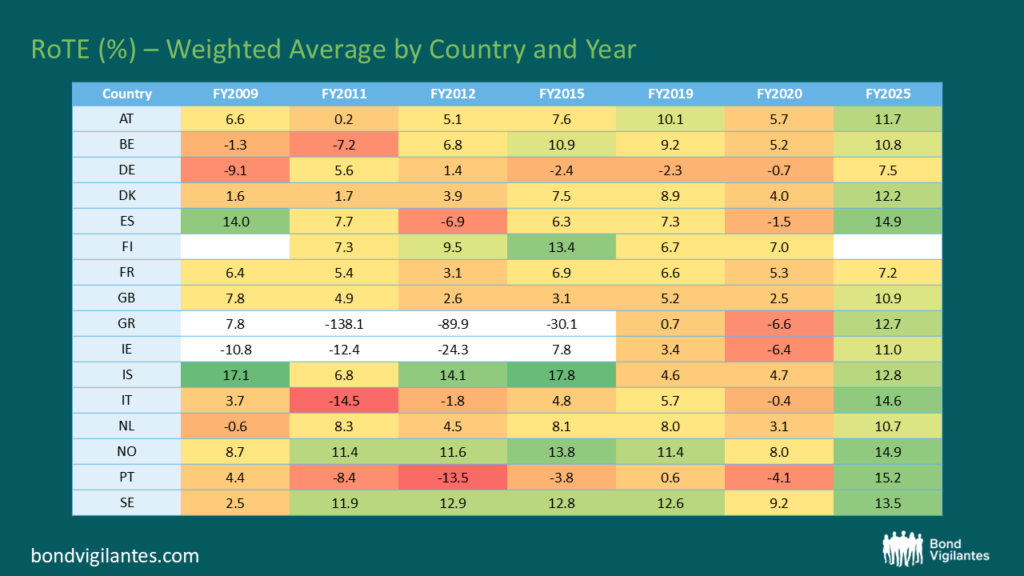
- European Bank Credit Opportunity: Bond Vigilantes presented a notable contrarian thesis, arguing that European bank fundamentals have materially improved. The analysis shows the sector's mean return on tangible equity (RoTE) has climbed to low-double digits with collapsing dispersion, while rating agencies have upgraded senior debt. The core argument is that the residual risk premium in European bank credit is now compensation for a largely mitigated risk, creating a relative value opportunity versus dollar-denominated bank bonds.
- Zombie Firm Contagion: A BIS research paper flagged a structural risk in Asia, finding that zombie firms (persistently unprofitable but kept alive by forbearance) create cross-border contagion channels. The study, covering 10 emerging Asian markets from 2005-2021, implies that corporate credit distress in one market can spill over via trade or financial linkages. This adds a regional risk premium to consider in emerging market debt allocations, particularly for sectors with high zombie prevalence.
Tomorrow's Setup
Asian markets will digest the US Treasury yield breach and oil's surge. The critical event is the Federal Reserve's interest rate decision, for which InvestingLive notes market pricing implies an 87% probability of a hike. The VIX at 17.34% and the 10-year yield at 4.98% set a cautious tone at the open. Key levels to watch are the S&P 500's 50-day moving average and gold's support near US$ 4,300. The overnight focus will be on any pre-Fed communication and Japanese bond market stability, per the Bond Vigilantes note on "Japan holding the trapdoor under this market." The open question is whether the Fed signals this is a one-off hike or the start of a new tightening sequence.
