EU Close Digest - 12 Aug 2026
AI-generated close market digest from curated financial newsflow.
The US 10‑year Treasury yield slipped to 4.67%, its lowest level since early July.
US Session Open & European Close
The S&P 500 opened higher, climbing 0.18% to 7,742 as the market digested the modest 0.1% month‑over‑month CPI gain reported by the BLS. The Nasdaq 100 outperformed, up 0.72% to 29,738, driven by tech‑heavy names that benefited from the “inflation‑driven Fed restraint” narrative in Bloomberg’s coverage. In contrast, the Euro Stoxx 50 closed down 0.33% at 6,530, reflecting Germany’s July CPI jump of 0.8% MoM and a 2.8% YoY headline rate from Destatis, which kept euro‑zone investors wary of a premature ECB tightening. Breadth was mixed in the US, with gains concentrated in information‑technology and consumer‑discretionary sectors, while energy lagged on the back of a flat Brent price at $88.84. The divergence between the US rally and the European sell‑off stemmed from the differing inflation readings – a subdued US CPI versus a re‑accelerating German CPI – and the RBA’s unchanged cash‑rate at 4.35% that reinforced a “wait‑and‑see” stance in the Asia‑Pacific region.
Analyst Consensus
- US Inflation & Fed Policy: Both Bloomberg and the BLS data show headline CPI rising only 0.1% MoM (BLS) versus 0.3% MoM (Bloomberg), while core CPI advanced 0.2% MoM in both releases. Bloomberg notes the core CPI increase was 0.2% YoY, 10 bps below the median forecast, suggesting a higher probability of a Fed rate pause. InvestingLive’s Collins commentary adds that a “conditional September hike” remains on the table if data deteriorates, reinforcing a bias toward short‑duration Treasuries. The implication is a modest upside risk to the 10‑year yield, but still limited by the “higher‑for‑longer” stance implied by the sticky core inflation reading.
- German Inflation & ECB Outlook: Destatis reports a 2.8% YoY CPI in July, up from 2.3% in June, with a 0.8% MoM increase driven by energy prices. This re‑acceleration contrasts with the broader euro‑zone trend of easing inflation and raises the risk of an earlier ECB tightening cycle. BIS research flags “energy‑shock persistence” as a driver of divergent monetary paths, implying that euro‑zone sovereign yields could rise if the ECB reacts to the German data. The consensus across the newsletters is that the euro‑linked bond market may see a short‑term premium expansion.
- Energy Markets & Gas Inventories: The EIA projects U.S. natural‑gas inventories at 3,985 Bcf for October 2026, the highest level since 2016, and forecasts 2026 marketed production at 122.5 Bcf/d, a 3.4% increase over the 2025 record. Both points suggest ample supply and downward pressure on Henry Hub forward curves. Bloomberg’s coverage of geopolitical tension in the Strait of Hormuz, however, notes a 2% rise in Brent futures, highlighting that oil‑price volatility could offset some of the gas‑price weakness. The net effect is a bearish stance on gas‑linked equities but a potential upside for LNG exporters that can absorb the surplus production.
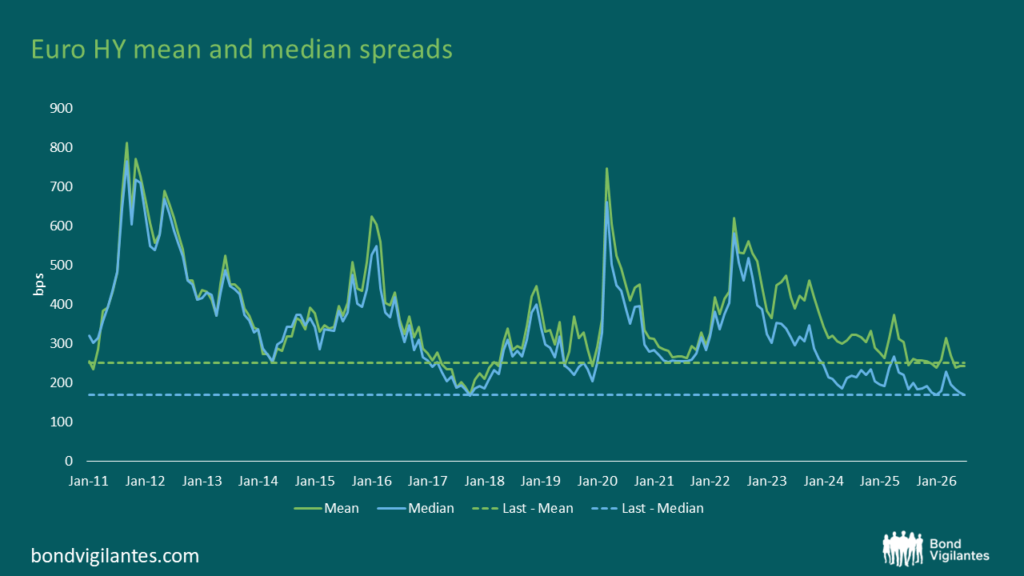
- European High‑Yield Credit Distortion: Bond Vigilantes’ analysis shows the mean spread of the ICE BofA Euro High‑Yield Index at 244 bps, while the median sits at 169 bps, indicating that a small distressed tail (4.3% of the index) inflates the headline average. This distortion suggests that investors should anchor valuations on the median spread rather than the headline mean, favoring single‑B issues where compensation is more representative of credit risk.
- Emerging‑Market Credit & Turkish Inflation: The TCMB press release shows core inflation at 55.1% YoY and headline at 58.2% YoY, with the policy rate held at 8.5% and a risk‑assessment paragraph warning that any sustained core‑inflation above 50% will trigger a 25 bps hike. BIS data also notes an $148 bn Q1 2026 inflow into EMDE credit, concentrated in Africa and the Middle East. Together, these signals point to heightened risk premia for Turkish‑linked sovereign and corporate bonds, while the broader EM credit pool may benefit from the influx of capital, especially in regions with lower inflation trajectories.
Tomorrow's Setup
Asian markets will open with a focus on the Japanese yen, where the BOJ kept its policy rate unchanged at –0.10% and the 3‑month T‑Bill discount rate is projected at 0.02%, suggesting a flat short‑end yield curve. In the US, the key catalyst will be the release of the July CPI details at 8:30 a.m. ET; a surprise above the 0.1% MoM consensus could reignite expectations of a September Fed hike, pushing the 2‑year yield higher, while a weaker reading may reinforce the current pause narrative. Europe will watch the German CPI update for August (expected at 0.6% MoM) and the ECB’s next policy statement, with any indication of a rate move likely to move the euro‑zone 10‑year yield. Commodity traders should monitor Brent for any further spikes linked to Strait of Hormuz developments, and the EIA’s gas inventory forecast will be revisited in the weekly energy report. The single open question heading into tomorrow is whether the July US CPI will confirm the modest inflation slowdown or reveal renewed core‑price pressure that could force the Fed back onto a tightening path.
