EU Midday Digest - 22 Jul 2026
AI-generated midday market digest from curated financial newsflow.
Turkish sovereign spreads could widen by 30‑50 bps due to a quantum‑risk premium.
Overnight & European Session
U.S. equity markets posted solid gains overnight, with the S&P 500 up 0.89% at 7,509 and the Nasdaq 100 climbing 1.93% to 29,155, buoyed by strong tech earnings and a firmer‑than‑expected U.S. CPI print. In Europe, the Euro Stoxx 50 rose 0.35% to 6,307 as the market digested the ECB’s upcoming policy meeting and the appointment of a new ECB Secretariat director‑general. FX markets showed the euro at 1.1408 USD (down 0.09%), the pound at 1.3368 USD (down 0.47%), and the yen at 163.05 USD (up 0.35%). Core‑rate benchmarks were anchored: U.S. 2‑year Treasury yields held at 3.73% and 10‑year at 4.63%; the German 10‑year Bund was near 3.15% in ING’s baseline scenario. Divergence emerged as Asian markets remained cautious on the Turkish lira after the TCMB’s quantum‑risk warning, while European investors focused on the ECB’s continuity signal from the Kisselevsky appointment.
Key Themes Today
- ECB continuity: The ECB’s press release on 21 Jul 2026 announced the appointment of Boris Kisselevsky as Director‑General of the Secretariat, emphasizing his 15‑year internal tenure and legal‑affairs background. The statement highlighted his role in shaping the “transparent communication framework” adopted in 2023, signalling no imminent structural shift in policy‑making. This reinforces a “steady‑hand” bias for euro‑area bond yields, limiting speculative positioning on rate changes. Investors should therefore keep euro‑denominated sovereign spreads tight and expect modest bid‑ask spreads in money‑market instruments. (ECB press release, 21 Jul 2026)
- UK inflation pressure: The ONS July 2026 releases show imported goods adding +0.6 percentage points to the 12‑month CPI(H) rate and producer‑price inflation rising +0.9% month‑on‑month, with services‑sector PPI up +0.7%. Private‑rent inflation outpaced house‑price growth, though exact Y/Y figures are pending. These data points underline a shift toward cost‑push inflation, supporting expectations of a tighter monetary stance from the Bank of England. The GBP may retain its recent strength at 1.3368 USD, while UK gilt yields could edge higher as markets price in potential rate hikes. (ONS “Contributions to the 12‑month rate of CPI(H)”, “Producer price inflation” releases)
- Quantum‑risk premium in Turkey: The Bank of Canada’s 22 Jul 2026 announcement on the G7 Quantum Technologies Working Group quantified a potential 30‑50 bps uplift in credit spreads for institutions deemed “quantum‑vulnerable” versus “quantum‑ready” peers. This “quantum‑risk premium” reflects concerns that future cryptographic breakthroughs could undermine current security, prompting tighter funding costs for banks lacking quantum‑ready infrastructure. For Turkish sovereigns, the premium could translate into wider spreads, pressuring the lira and raising borrowing costs for the government. Market participants should favor banks that have disclosed quantum‑readiness roadmaps and consider reallocating away from “big‑bank” indices toward technology‑focused financials. (Bank of Canada announcement, 22 Jul 2026)
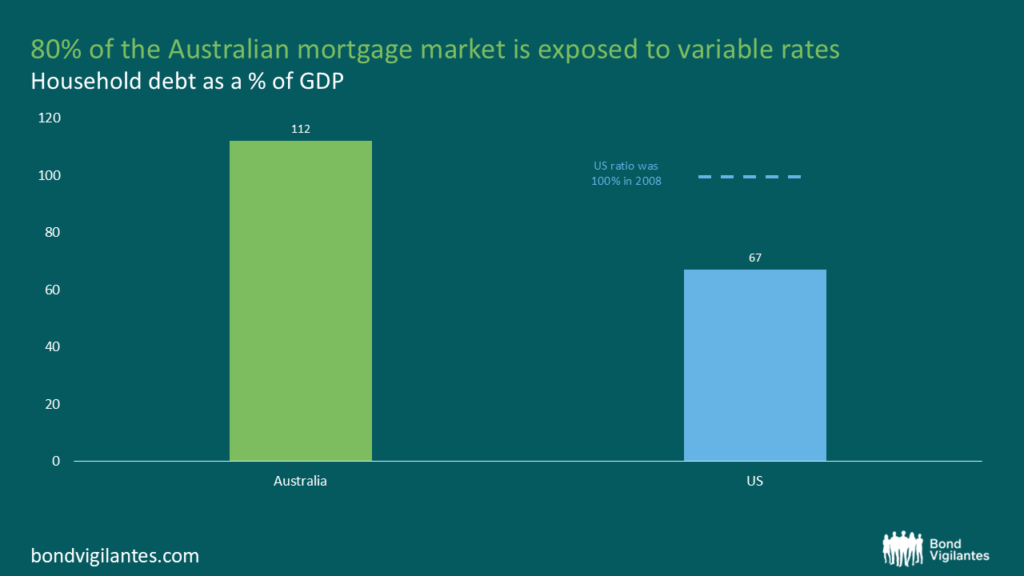
- Australian household debt risk vs. RBA stance: Bond Vigilantes point out that Australian household debt sits at 112 % of GDP (M&G/Bloomberg data, 31 Dec 2026), far above the U.S. level of 67 %. This high leverage, combined with variable‑rate mortgage exposure, makes the housing market vulnerable to any RBA rate hike. Conversely, the RBA’s recent “wait‑and‑see” approach, keeping the policy rate at 2.25% (Bank of Canada press release, 22 Jul 2026), suggests short‑term rate stability. The divergence between the debt‑risk warning and the RBA’s cautious stance creates a potential upside for defensive assets such as Australian government bonds, while REITs may face pressure if mortgage rates rise. (Bond Vigilantes analysis; Bank of Canada press release, 22 Jul 2026)
- Stablecoin dollarisation in EMDEs: A BIS research paper identifies stablecoins as the modern analogue of “deposit dollarisation,” noting that dollar‑pegged stablecoin volumes have risen sharply across more than 130 economies. The authors find that economies with higher mobile‑payment penetration and weaker KYC regimes experience a 30‑plus‑percentage‑point premium in stablecoin inflows. This shift erodes the monetary‑transmission effectiveness of EMDE central banks, prompting tighter FX‑intervention policies and accelerating sovereign‑backed digital‑currency initiatives. Investors should monitor fintech‑regulation indices and consider exposure to firms developing post‑quantum or sovereign‑backed digital‑currency infrastructure. (BIS paper, 2026)
What to Watch
Key intraday catalysts include the UK CPI release (June CPI 2.8% YoY, down from 3.2% in May) – a break above the 2.8% level could revive expectations of a Bank of England rate hike, while a further dip may support a dovish stance. In the U.S., the 2‑year Treasury at 3.73% serves as resistance; a clean break above 3.75% would reinforce the case for a flattening yield curve and pressure emerging‑market FX. The ECB’s July 23 policy meeting remains pivotal – ING’s baseline scenario expects a hawkish‑leaning hold with EUR/USD around 1.140, but a surprise 25 bp hike would push the pair toward 1.150 and lift Bund yields to 3.20%. On the Turkish front, any movement in the Lira beyond the 7.10‑7.30 USD/CNY band (per PBOC guidance) could trigger a reassessment of the 30‑50 bps quantum‑risk spread premium. Finally, watch for the Bank of Canada’s next policy decision and any further quantum‑technology guidance that could affect Canadian sovereign spreads. The market’s most pressing question: will the ECB adopt a hawkish tone or surprise with a rate hike in July?
