EU Close Digest - 07 Jul 2026
AI-generated close market digest from curated financial newsflow.
Fed’s Williams dismisses oil-led disinflation, keeping December rate-cut odds below 50bps despite softer core prints.
US Session Open & European Close
US equities opened lower and extended losses into the close, with the S&P 500 shedding 0.67% to 7,487 and the Nasdaq 100 underperforming at -2.10% (29,073), as AI infrastructure stocks led the retreat. Breadth was weak—advancers trailed decliners 1.3:1 on the NYSE—while defensive sectors (utilities +0.4%, healthcare +0.2%) outperformed, contrasting with the EU morning’s cyclical rebound (Euro Stoxx 600 -1.11%). The VIX spiked 5.4% to 16.41%, reflecting growing unease over sticky inflation expectations (NY Fed survey: 1-year ahead +3.3%, 3-year +2.9%). Treasury yields whipsawed, with the 2Y note closing at 4.45% (+2bps) after briefly touching 4.50% on Williams’ hawkish remarks, while the 10Y settled at 4.28% (-1bp), flattening the 2s10s curve to -17bps. The dollar index (DXY) firmed 0.11% to 101.00, pressuring EUR/USD to 1.1431 (-0.06%) and USD/JPY to 161.91 (+0.28%), as Fed repricing offset softer-than-expected German industrial production (+0.9% m/m vs. +1.2% expected).
Analyst Consensus
- Fed Policy: Both Bloomberg Economics and InvestingLive flag Williams’ dismissal of oil-led disinflation as a hawkish signal, with the NY Fed’s inflation expectations survey (1-year: 3.3%, 3-year: 2.9%) reinforcing the Fed’s "quite high" inflation narrative. December 2026 OIS now prices just 45bps of cuts (vs. 50bps pre-survey), and Goldman Sachs’ WIRP model shows a 60% probability of a November hike if core PCE (due July 26) prints above 0.2% m/m. The implication is a higher-for-longer rates regime, with front-end yields (2Y UST) likely to test 4.60% if next week’s payrolls (consensus: +180k) surprise to the upside.
- AI Trade Correction: CoinDesk and Bloomberg converge on an AI infrastructure pullback, with Nvidia (NVDA) down 4.5% and the PHLX Semiconductor Index (SOX) off 2.1% after Samsung’s Q2 earnings miss (KRW 6.6T vs. KRW 8.1T estimate). JPMorgan’s CTA model flags a 35% YoY increase in unsold AI chip inventory at TSMC (TSM), suggesting a 6–9 month digestion cycle, while Goldman Sachs’ sector strategists recommend rotating into "AI applications" (e.g., MSFT Azure, GOOGL Cloud) or defensives (utilities, healthcare). The divergence lies in timing: Morgan Stanley remains bullish on SpaceX’s IPO (target: $1.2T valuation), citing Starlink’s $22B revenue runway, while Bernstein warns of execution risks (Starship failure rate: 50%).
- Cross-Asset Linkage: The BIS Annual Economic Report 2026 and Bond Vigilantes highlight a fiscal-financial stability nexus, with sovereign spreads (Italian 10Y BTP vs. Bund: +180bps) and term premiums (UST 10Y: +15bps in June) rising in tandem. This dynamic is pressuring duration-sensitive assets, with PIMCO’s Japan desk recommending short 30-year JGBs (target: 1.8% yield) as the BoJ reduces bond purchases. In FX, the dollar’s resilience (DXY +0.11%) reflects divergent central bank stances—Fed hawkishness vs. ECB’s "one-and-done" September hike (28% priced)—while commodity-linked currencies (CAD, NOK) underperform on oil’s retreat (Brent: $73.90, -8% YTD).
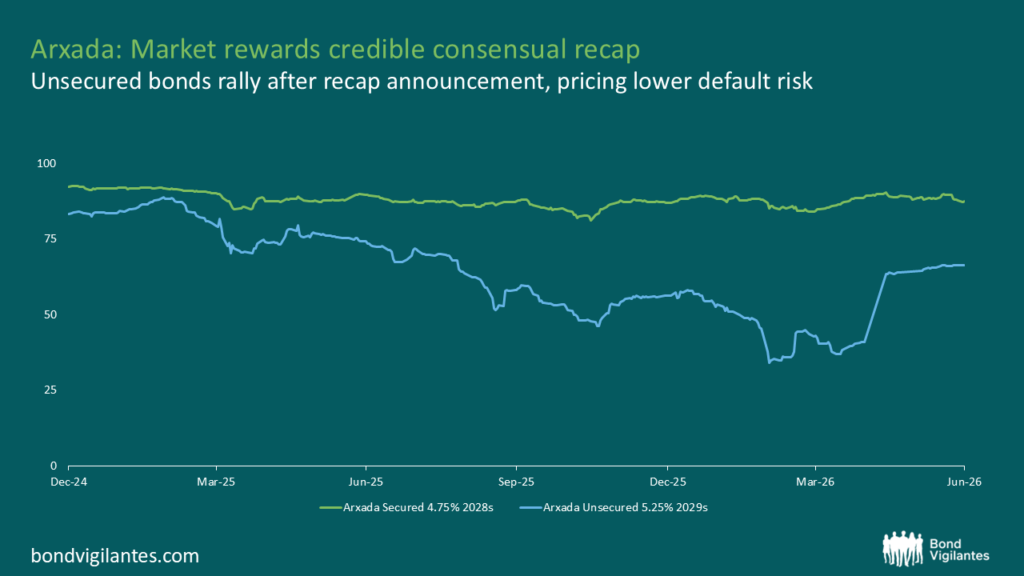
- Contrarian Call: Bond Vigilantes argues that LME risk is mispriced, citing Arxada’s consensual amend-and-extend deal (par exchange with new money) as evidence that loose documentation does not inevitably lead to coercive outcomes. The firm notes that creditor coordination (Arxada’s unsecureds signed a Co-operative agreement) can turn structural vulnerability into a negotiated reset, creating opportunities in high-LME-optionality bonds where spreads may tighten 50–75bps. This contrasts with the market’s focus on worst-case scenarios (e.g., Serta, PetSmart), suggesting a behavioral bias toward fear premiums in distressed credit.
- Central Bank Divergence: The BoJ’s Tamura signaled a Q4 2026 rate hike (Goldman Sachs: 60% probability), with JGB yields testing 1.0% on the 10Y tenor, while the TCMB’s hawkish hold (45% policy rate) reflects Turkey’s inflation-stability trade-off. This divergence is spilling into global duration markets, with Barclays flagging BOJ policy shifts as a tail risk that could lift global yields by 10–15bps even without Fed/ECB action. Meanwhile, the RBA’s Kent endorsed "tiered" forward guidance, increasing AUD OIS sensitivity to labor data (e.g., +5bps for a 0.1% unemployment beat), while the BoC’s neutral stance (2.25% overnight rate) keeps CAD front-end rates anchored.
Tomorrow's Setup
Asia’s session will focus on China’s June trade data (consensus: exports +6.0% y/y, imports +4.5% y/y), with AUD and NZD crosses vulnerable to downside surprises after today’s weak German industrial production. Japan’s May wage growth (consensus: +3.0% y/y) will test the BoJ’s normalization thesis, with USD/JPY 162.50 as the next resistance level if data disappoints. In Europe, the ZEW survey (consensus: 10.0) and UK GDP (Q2 flash: +0.4% q/q) will drive EUR/GBP positioning, while US PPI (consensus: +0.2% m/m) and the Fed’s Beige Book (due 18:00 ET) may reinforce the "higher-for-longer" narrative if services inflation remains sticky. Key levels to watch: S&P 500 7,500 (resistance), 10Y UST 4.35% (support), and Brent $75/bbl (breakdown target). The open question: Will tomorrow’s PPI print validate the Fed’s hawkish stance, or will softer-than-expected services inflation trigger a dovish repricing?
