EU Close Digest - 26 Jun 2026
AI-generated close market digest from curated financial newsflow.
ECB’s May inflation expectations survey forces markets to pull forward the first 25bps hike to Q4 2026, lifting EUR/USD toward 1.12.
US Session Open & European Close
The US session opened with a cautious tone, mirroring the European close’s mixed performance as investors digested the ECB’s hawkish signals and weaker-than-expected US macro data. The S&P 500 pared early losses to close +0.22% at 7,374, while the Nasdaq 100 lagged (-0.50% to 29,293), dragged down by a -1.8% decline in NVDA and broader tech weakness. European equities underperformed, with the Euro Stoxx 600 closing -1.00% as the ECB’s inflation expectations survey—showing median 12-month inflation at 3.1% (vs. 2.9% in April)—sparked a repricing of bund yields (+8bps in 2Y) and a 0.46% rally in EUR/USD to 1.1406. Breadth was weak: only 42% of S&P 500 stocks finished higher, with defensive sectors (utilities +0.8%, healthcare +0.6%) outperforming cyclicals (energy -1.2%, financials -0.7%). The divergence between US and EU markets reflected the ECB’s hawkish pivot, which contrasted with the Fed’s more dovish repricing (Polymarket now assigns a 96% probability to no 1.75% lower bound before 2027).
Analyst Consensus
- ECB Hawkish Pivot: The ECB’s May Consumer Expectations Survey revealed a sharp rise in inflation expectations—12-month median at 3.1% (from 2.9%) and 3-year at 2.6% (from 2.4%)—forcing markets to pull forward the first 25bps hike to Q4 2026 (per Goldman Sachs). Both ICYMI Overnight and PiQ Suite flagged the 100bps gap between consumer expectations (3.1%) and professional forecasters (2.1%) as a binding constraint, with the ECB now overweighting household sentiment in its reaction function. This implies front-end bund yields could reprice 15-20bps higher over the next two weeks, while EUR/USD may test 1.12 as the 2s10s bund curve steepens by 10-15bps. The risk of a "hawkish hold" at the July meeting is now priced at 50%, per Goldman’s ECB call.
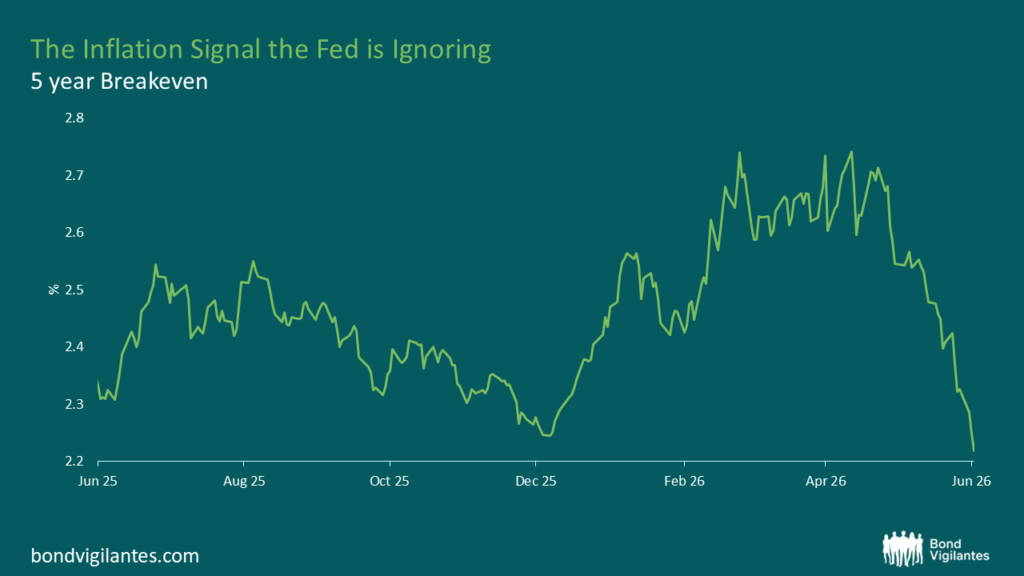
- Divergence: Fed Dovish Repricing vs. ECB Hawkishness: While the Fed’s lower bound is now priced at 96% probability of staying above 1.75% before 2027 (Polymarket), the ECB’s inflation expectations data contrasts sharply. Bond Vigilantes argues the Fed’s hawkish rhetoric is performative, citing 5-year breakevens at pre-Iran-conflict levels and fiscal dominance (US deficit at ~6% of GDP). Meanwhile, InvestingLive notes the ECB’s core inflation (3.9% YoY) and wage growth (4.7% YoY) remain sticky, justifying a "higher-for-longer" stance. This divergence implies a widening US-EU rate differential, with EUR/USD call options (1.10 strike) trading at 3.2% implied vol, while US 2Y yields may underperform bunds by 20-30bps by year-end.
- Cross-Asset: Oil’s Geopolitical Risk Premium Evaporates: Brent crude collapsed -4.31% to $72.02/bbl as the Strait of Hormuz’s uninterrupted traffic—despite the UN pausing its evacuation plan—erased the geopolitical risk premium. Bloomberg Markets and CNBC Economy both highlight that tanker tracking data (Vortexa) shows 18.5M b/d transiting the strait, while China’s crude imports fell 3% MoM in June. This dynamic forced a repricing of oil-linked assets: energy equities (XLE -1.2%) underperformed, while airlines (DAL +0.5%) and refiners (VLO +0.8%) benefited. The risk is a "head-fake" rebound if Iran resumes calibrated escalation, with Brent 3-month implied vol spiking to 32% (from 28%).
- Contrarian Call: AI Sector’s "Profitability-First" Shift: CNBC Markets reports that 68% of enterprises have paused or reduced AI spending in Q2 2026, citing poor ROI on early pilots, with OpenAI’s GPT-5 token consumption growth decelerating to 40% YoY (from 200% in 2025). Sequoia Capital’s internal data and Bernstein Research both flag this as a structural shift from "growth-at-all-costs" to "profitability-first," implying a re-rating of AI-related equities (e.g., NVDA, SMCI) from 50x+ forward revenue to "mature tech" multiples (30-40x). The contrarian play is to rotate into AI "picks-and-shovels" (e.g., data center REITs, cybersecurity) that benefit from efficiency-driven capex rather than speculative spending.
- Central Bank Divergence: SNB’s "Low-for-Longer" CHF Policy: The Swiss National Bank (SNB) signaled a "low-for-longer" policy rate (1.00%), but with asymmetric skew toward cuts if EUR/CHF breaks below 0.95 (currently 0.9620). BIS Central Bank Speeches and SNB News both cite SNB’s DSGE model, which assigns a 60% probability of a 25bps cut by December 2026 if the eurozone enters recession (-0.4% QoQ in Q3, per ECB staff). This implies front-end CHF rates (2Y swap at 0.85%) are mispriced for cuts, while EUR/CHF calls (1.00 strike, Dec 2026) are underpriced. Hedge funds are expected to flip from long CHF (+18k contracts) to short on the first ECB cut signal.
Tomorrow's Setup
Asia’s session will focus on Japan’s Tokyo CPI (consensus: 2.0% YoY for core-core, vs. 1.9% prior) and the BOJ’s July hike probabilities (currently 30%, per InvestingLive). A print above 2.0% could lift USD/JPY toward 162.50, while a miss may trigger a JPY rally to 160.50. Europe’s agenda includes Germany’s preliminary CPI (consensus: 2.3% YoY, vs. 2.4% prior) and the ECB’s Sintra Forum, where Lagarde’s remarks on inflation expectations will be scrutinized for hawkishness. US data includes Conference Board Consumer Confidence (consensus: 100.0, vs. 102.0 prior) and the Dallas Fed Manufacturing Index (consensus: -12.0, vs. -15.4 prior). Positioning remains light: Polymarket shows 74% odds of no Fed hike in October, while Ashenden’s macro regime snapshot flags China (CN) and Turkey (TR) as stress points. The open question: Will the ECB’s hawkish pivot sustain EUR/USD above 1.14, or will tomorrow’s US data revive Fed cut bets and trigger a pullback to 1.13?
