EU Midday Digest - 26 Jun 2026
AI-generated midday market digest from curated financial newsflow.
ECB consumer inflation expectations at 2.3% clash with sticky wage growth, splitting September rate-cut odds 50/50.
Overnight & European Session
Global risk assets opened on the defensive after Asia’s tech-led sell-off—Nikkei 225 down 4.15% to 69,361—spilled into Europe, where the Euro Stoxx 600 fell 0.8% at the open. The move was driven by a 2.8% drop in the PHLX Semiconductor Index (SOX) and a 7.5% plunge in AI-adjacent software names (SNOW, MDB, CRWD) after OpenAI delayed its IPO, per Bloomberg. FX markets saw a classic flight-to-safety bid: USD/JPY dipped 0.11% to 161.59, while EUR/USD rallied 0.47% to 1.1408 on ECB survey data showing 1-year-ahead inflation expectations at 2.3% (down from 3.1% in March). Front-end rates repriced sharply: German 2Y bund yields fell 5bps to 2.60%, and 2Y OIS now price only a 40% chance of a July ECB cut (down from 60% pre-survey). The divergence between Asia’s tech rout and Europe’s disinflation narrative kept volatility elevated, with the VIX at 20.15% (+6.67% overnight).
Key Themes Today
- ECB’s inflation expectations vs. wage growth divergence: The ECB’s May Consumer Expectations Survey showed median 1-year-ahead inflation expectations steady at 2.5%, while 3-year expectations ticked down to 2.3% (from 2.4%), per the ECB. This aligns with the Bank’s June staff projections revising 2026 HICP inflation to 2.2% (from 2.3% in March), reinforcing a "wait-and-see" stance after the June cut. However, Goldman Sachs’ "wage surprise index" for the euro area hit +0.8 in June (vs. -0.2 in May), the highest since 2023, as German IG Metall secured a 5.5% settlement (vs. 4.5% in 2025). This divergence creates binary risks for September: if wage data confirms the ECB’s view, EUR 2Y swaps could reprice 15-20bps lower (currently at 2.55%), while a reacceleration would force markets to price out cuts entirely, lifting EUR/USD toward 1.15. Source: ECB, Goldman Sachs.
- Stablecoins as a systemic risk to bank funding and monetary policy: The BIS warns that stablecoins are evolving into direct substitutes for bank deposits and money market funds (MMFs), with ~40% of the $300bn in exchange-held stablecoin balances now earning yields. Hofmann et al. (BIS) model a 10% shift of household deposits into stablecoins raising bank funding costs by ~30bps and reducing loan supply by 0.5% of GDP, while simultaneously lowering 10-year Treasury yields by ~20bps. This dual channel—tightening bank lending while loosening fiscal constraints—creates a policy dilemma: easing to support banks could inflate asset bubbles, while tightening risks exacerbating funding stress. The market implication is a structural bid for compliant stablecoins (e.g., USDC, PYUSD) and a widening of bank credit spreads (e.g., iTraxx Europe Crossover +20-30bps in H2 2026). Source: BIS.
- JPY’s hawkish repricing on BOJ’s inflation sensitivity: Bank of Japan (BOJ) Governor Ueda’s June 26 remarks, combined with Tokyo core-core CPI at 1.9% (vs. 1.6% in May), have forced markets to reprice the odds of a July hike. Daiwa Institute of Research links the Middle East energy shock to rising electricity and food prices, while Norinchukin’s Takeshi Minami counters that global disinflation will cap core CPI below the BOJ’s 3% projection. The divergence is playing out in rates: 2Y JGB yields rose 3bps to 0.35% overnight, and USD/JPY 1-month risk reversals flipped to a 0.5% call skew (from 0.2% put skew pre-data). If the BOJ hikes in July, expect a 10-15bps backup in 2Y JGBs and a 2-3% JPY rally (USD/JPY target 158); if it pauses, JPY longs could unwind violently. Source: InvestingLive, Daiwa Institute of Research.
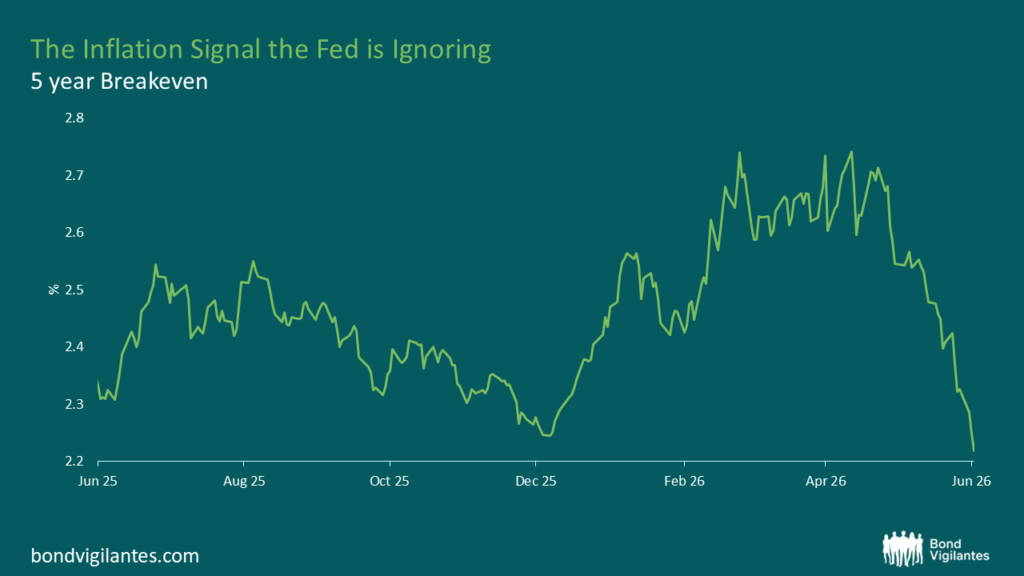
- [DIVERGENCE] Fed’s hawkish rhetoric vs. inflation expectations: Bond Vigilantes argue the Fed’s hawkish pivot—driven by Kevin Warsh’s need to prove independence—is out of step with market-based inflation signals. 5-year breakeven inflation rates have fallen below pre-Iran energy shock levels, and the Fed’s preferred PCE gauge (core at 2.8% YoY in May) is not translating into broad-based inflation pressure. Meanwhile, fiscal dominance (deficits at ~6% of GDP, net interest costs exceeding $1 trillion annually) makes a sustained tightening cycle untenable. The divergence implies front-end real yields (2Y at 2%) are "over-priced" for a tightening that likely won’t materialize. Positioning: long 2Y Treasuries (target 4.50%) and steepeners (2s10s) to profit from either a Fed pause or a fiscal-driven term premium repricing. Source: Bond Vigilantes.
- Turkey’s macroprudential pivot tightens credit, pressures TRY: The Central Bank of the Republic of Turkey (TCMB) introduced higher risk weights for consumer loans (+10pp) and tighter LTV ratios for mortgages (capped at 70%) to cool domestic demand, per TCMB’s June 2026 release. However, with retail credit growth at ~25% YoY and core inflation sticky at ~45%, the measures may be insufficient without deeper structural reforms. The market implication is a widening of TRY volatility (1M implied vol at 18%) and a repricing of local bonds: 2Y TRY yields rose 50bps to 52% on the announcement, while CDS spreads (5Y at 320bps) remain elevated. If the TCMB fails to address fiscal imbalances (budget deficit at 6.5% of GDP), TRY could test 30.00 against the USD. Source: TCMB.
What to Watch
Today’s intraday catalysts center on US data: May PCE deflator (consensus 0.1% m/m, 2.6% y/y) and June Chicago PMI (consensus 48.5) at 8:30 ET and 9:45 ET, respectively. A PCE print above 0.2% m/m would reinforce the "higher-for-longer" narrative, targeting 10Y UST 4.35% resistance (a break confirms the reflation trade and pressures EM FX). ECB’s Cipollone speaks at 10:00 ET; watch for hints on CBDC remuneration tiers, which could steepen front-end Bunds (2Y target 2.65%). In Asia, Japan’s May industrial production (consensus -0.5% m/m) at 19:30 ET will test the BOJ’s July hike thesis—weak data could trigger a USD/JPY squeeze toward 163. The key divergence to monitor: whether ECB wage data (released Friday) confirms the survey’s disinflation signal or aligns with Goldman’s reacceleration view. The market’s open question: Can the Fed credibly tighten further with fiscal deficits at 6% of GDP and inflation expectations anchored below 2.5%?
