EU Midday Digest - 25 Jun 2026
AI-generated midday market digest from curated financial newsflow.
Swiss National Bank’s CHF 20 billion bill auctions signal prolonged tightening amid sticky inflation and housing risks.
Overnight & European Session
The Euro Stoxx rose 0.73% to 6,260 as European equities outperformed amid easing inflation fears, while the S&P 500 dipped 0.10% to 7,358 and the Nasdaq 100 fell 0.43% to 29,220, reflecting profit-taking in U.S. tech. The DXY held near 102 as EUR/USD slipped to 1.1356, while USD/JPY edged up to 161.83 on persistent BoJ policy divergence. Gilt returns surged to a three-month high as falling oil prices eased UK inflation risks, pushing long-duration yields lower. The Nikkei 225 jumped 4.61% to 72,366, driven by JGB stability and optimism over Japan’s budget framework, despite its limited fiscal credibility.
Key Themes Today
- SNB Reinforces Hawkish Stance via Bill Auctions: The Swiss National Bank is using CHF 20 billion in new 3- and 6-month bill auctions to maintain monetary tightening, signaling that rate cuts are off the table despite global easing trends. Core CPI remains at 2.1% YoY and wage growth has accelerated to 3.4% YoY, while housing prices rose 15% YoY, creating a policy trilemma between inflation, financial stability, and growth. This reinforces CHF strength—EUR/CHF is now targeting 0.92–0.93—and increases pressure on Swiss equities (SMI) due to margin compression. Goldman Sachs’ CTA model expects front-end CHF rates to rise 15–20 bps by Q4 2026, while JPMorgan sees Swiss 2Y yields rising 25 bps as the SNB diverges from the ECB’s dovish pivot (SNB vs. ECB divergence per Bloomberg Economics).
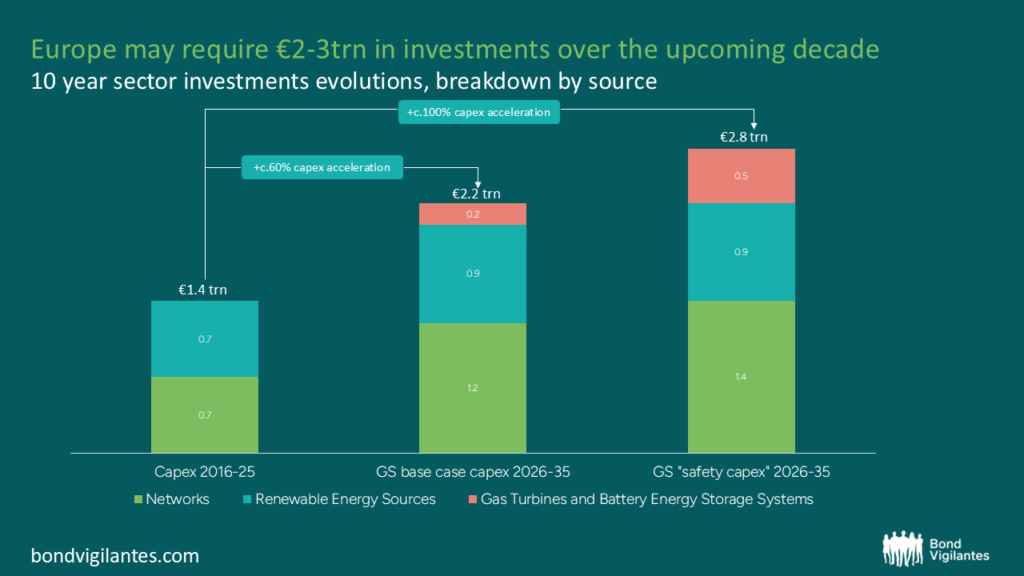
- European Utilities Face Debt Wall from €2–3 Trillion Grid Investment: Goldman Sachs estimates European utilities will require €2–3 trillion in capital spending by 2035, with €580 billion needed just for 2026–30, driving a wave of euro-denominated bond issuance. With 85% of projects regulated, bondholders have some security, but FFO-to-net-debt ratios will deteriorate due to front-loaded capex and delayed cash flows. Execution risk—simultaneous grid modernization, renewables buildout, and datacentre integration—will become the dominant credit driver, favoring firms with proven delivery records. Bond Vigilantes warns of widening spreads and re-rating risk, especially for utilities unable to recycle capital via asset sales or partnerships.
- Stablecoins Exert Dual Pressure on Monetary-Fiscal Transmission: BIS research shows remunerated stablecoins simultaneously raise bank funding costs (by competing for deposits) and lower sovereign yields (by absorbing Treasury bills), creating a split in monetary-fiscal dynamics. In high-adoption regimes like Switzerland and Sweden, this erodes central banks’ control over safe, interest-bearing liquidity, weakening deposit stickiness and rate pass-through. The fiscal space channel supports government borrowing, but tighter credit conditions offset expansionary effects—investors should monitor the sovereign-Treasury basis and bank loan growth. This structural shift may accelerate CBDC development, as argued in the BIS Annual Economic Report 2026.
- Fed’s Bank Stress Test Sparks Complacency Debate: The Fed’s 2026 CCAR results show large banks would maintain CET1 ratios above 9.2% even under a 10% unemployment, 5% GDP contraction scenario, supporting equity overweight positions in JPM, BAC, and WFC. However, the Ashenden source_score of 4.9/10 reflects skepticism about the stress assumptions, which exclude liquidity shocks or cyber risks. While the Fed sees resilience, some analysts see complacency—this gap could fuel volatility if real-world conditions mirror the test parameters. The divergence between regulatory confidence and market doubt creates a potential mispricing in financial stocks, per Federal Reserve vs. Ashenden analysis.
- Japan’s Budget Reform Lacks Fiscal Credibility, Reinforcing BOJ Dominance: Japan’s new multi-year budget framework sets a primary balance goal of 1% of GDP by 2030 but lacks annual targets, rendering it irrelevant for JGB markets. BOJ Governor Ueda dismissed it as “not material” for policy, and 10Y yields remain anchored at 0.95% with the BOJ holding 54% of outstanding debt. This reinforces the “BOJ put”—any yield spike above 1.1% will trigger intervention, per MUFG’s rates strategy. With no fiscal tightening, JPY remains a funding currency, and USD/JPY 160 calls are priced at a 20% implied probability (Bloomberg Economics).
What to Watch
The UK gilt market will react to the ONS’s experimental real-time indicators, though no finance-anchored metrics are released—traders should monitor for future citation by the MPC, which could elevate their influence on short-duration gilts. U.S. small business credit trends remain weak, with 42% of firms under three years old reporting loan denials in Q1 2026, per Fed data, increasing downside risk to capex and labor demand. Polymarket pricing shows a 96% probability the Fed’s lower bound won’t reach 1.75% before 2027, aligning with Bessent’s “tap the brakes” analogy signaling a potential September hike. No consensus level identified for EUR/CHF, but a break below 0.92 could trigger SNB verbal intervention, while a move above 0.95 may prompt stealth FX selling. Is the SNB’s tolerance for CHF strength unlimited, or will housing risks force a policy pivot?
