EU Close Digest - 24 Jun 2026
AI-generated close market digest from curated financial newsflow.
Bitcoin breaks below Rainbow Chart support for the first time since 2020, signaling structural bearish momentum.
US Session Open & European Close
The S&P 500 opened higher, closing at 7,420 (+0.74%), while the Nasdaq 100 gained 0.41% to 29,469, supported by a rebound in tech ahead of Micron’s earnings. This contrasted with a weaker European close, where the Euro Stoxx fell 0.38% to 6,207 amid persistent concerns over German fiscal drift and utility sector leverage. The divergence reflected differing regional risk exposures: US markets drew confidence from resilient domestic demand and a dip in the VIX to 18.23% (-6.46%), while Europe grappled with rising Bund yields and political uncertainty in defense procurement. No intraday reversal occurred, but sector rotation favored US energy and financials as oil prices dropped and rate-cut bets faded.
Analyst Consensus
- Crypto Regime Shift: Bitcoin’s breakdown below the Rainbow Chart’s lower bound—labeled the “BTC is dead” zone—marks a structural bearish shift, with 10x Research projecting a drop to $55,000 on deteriorating on-chain metrics. CoinDesk notes this breach invalidates a long-standing technical floor, increasing downside risk for leveraged longs and mining equities. Both CoinDesk and Bloomberg highlight a macro-driven unwind of the “debasement trade,” with gold and silver also selling off as real yields rose. This coordinated move suggests a broader repricing of inflation-hedge assets, not just crypto-specific weakness.
- Stablecoin Policy Divergence: The BIS paper by Hofmann et al. (2026) argues stablecoins suppress sovereign borrowing costs by boosting demand for Treasury bills, creating fiscal space. However, CoinDesk highlights a domestic policy split: the American Bankers Association warns of financial stability risks, while fintech advocates point to pilot programs where community banks used USD-backed tokens to cut settlement costs. This divergence—between systemic benefit and institutional resistance—could shape regulatory outcomes in the US and UK, where execution lags rhetoric.
- Commodity & FX Regime: WTI crude fell below $70/bbl on improved Middle East transit flows and US political pressure, while gold dropped below $4,000/oz as the DXY rose to 102 (+0.16%). Bloomberg links both moves to a stronger dollar and higher real yields, creating a dollar-positive, commodity-negative regime. This benefits importers like India and Turkey but pressures commodity exporters and AUD/NDX correlations. The divergence between oil (supply-driven drop) and gold (monetary-driven sell-off) suggests different trade setups: short oil/long dollar vs. potential long gold dips if real yields peak.
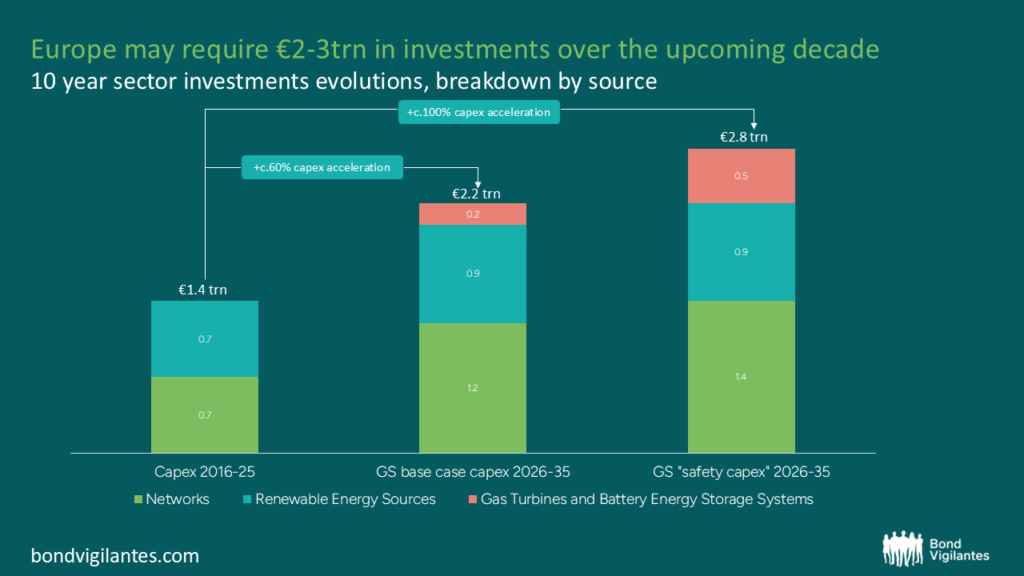
- European Utility Credit Risk: Goldman Sachs estimates €2–3 trillion in European utility capex by 2035, with €580 billion needed by 2030—mostly debt-financed. Bond Vigilantes warns this creates a sovereign-linked, high-duration credit pipeline that could widen spreads due to supply pressure. Execution risk, not commodity exposure, is now the primary credit driver, with rating agencies tolerating higher leverage but investors demanding compensation via step-up coupons or covenants. This implies a reassessment of utility bonds as quasi-sovereign paper with elevated project risk.
- Manufacturing Labor Disconnect: Despite a June PMI expansion, S&P data shows factory job cuts approaching 2008–2020 crisis levels, indicating a restocking-driven rebound without hiring. CNBC argues this “jobless recovery” risks a Q3 double-dip once inventories normalize, underpinning dovish Treasury positioning. The disconnect suggests equities may be overpricing a cyclical recovery, particularly in industrials and capital goods. If services labor weakens, it could force earlier Fed rate cuts, boosting 2- and 5-year duration.
Tomorrow's Setup
Asian markets are likely to open under pressure as USD/JPY holds near 161.78 and BOJ Governor Ueda’s hawkish signals reinforce JPY bulls. No consensus level identified for Nikkei or Hang Seng, but focus will be on Chinese industrial data and any commentary from PBOC on yuan stability. US futures are flat, with attention on Micron’s earnings after the close and the May new-home sales print (consensus: 620k). Polymarket shows 96% odds the Fed won’t cut to 1.75% before 2027, aligning with Warsh’s hawkish tone and 5-year breakevens at 2.4%. The open question: can tech sustain its rally if Micron misses, or will the “debasement trade” unwind extend into equities?
