EU Midday Digest - 05 Jun 2026
AI-generated midday market digest from curated financial newsflow.
Project Agorá’s 40% FX-swap settlement compression threatens CAD/USD 3-month basis swaps at -8bps, forcing hedge funds to unwind short-basis positions.
Overnight & European Session
Global risk assets opened on a cautious footing after Asian equities (Nikkei 225 -1.31% to 66,588) digested the Bank of Canada’s Project Agorá announcement, which confirmed a 40% reduction in end-to-end settlement time for tokenized FX swaps. The CAD/USD 3-month cross-currency basis tightened 6bps overnight to -8bps, its lowest level since March, as hedge funds unwound 22% of net speculative short-basis positions (CFTC Commitments of Traders, 3 June). European equities followed Asia lower (Euro Stoxx -0.01% to 6,103), while US equity futures pointed to a modest rebound (S&P 500 +0.41% to 7,584). Core rates rallied across the curve, with US 10Y yields falling 3.1bps to 4.48% and 2Y yields down 0.8bps to 3.62%, as markets priced a 92% probability of no Fed rate change in July (Polymarket). The DXY index softened 0.22% to 99.00, with EUR/USD rising 0.32% to 1.1647 and GBP/USD up 0.42% to 1.3483. Brent crude held steady at US$ 94.70 (-0.35%), while gold edged higher to US$ 4,494 (+0.41%). The divergence between Asia’s risk-off tone and Europe’s muted rebound reflects positioning adjustments ahead of today’s US jobs report, with CAD and JPY the most sensitive to cross-currency basis dynamics.
Key Themes Today
- CAD liquidity revolution: The Bank of Canada’s Project Agorá is engineering a structural shift in CAD liquidity pools by testing tokenized commercial-bank deposits and wholesale CBDC on a shared ledger. The BIS Innovation Hub’s 2025 pilot demonstrated a 40% reduction in end-to-end settlement time for tokenized FX swaps, while Bank of Canada staff analytics estimate the CAD/USD 3-month cross-currency basis could compress from -8bps to -2bps within two years of full implementation. The shared-ledger architecture eliminates Herstatt risk via atomic settlement, which has already triggered a 22% week-over-week reduction in net speculative short-basis positions (CFTC data). The broader context is a direct challenge to the CHIPS/Fedwire duopoly, with the Bank of Canada’s permissioned Ethereum side-chain creating a competing USD settlement rail. By 2028, 5-7% of CAD-denominated USD payments could shift from CHIPS to Agorá, pressuring transaction fees for US money-center banks (JPM, C, BAC) and tightening front-end CAD funding spreads by 3-5bps over the next 12 months (Bank of Canada press release).
- ECB digital euro as geopolitical wedge: Piero Cipollone (ECB Executive Board) frames the digital euro as a strategic sovereignty play to counter the rise of private stablecoins and foreign CBDCs. The ECB’s 2025 stress tests show that a 30% adoption of non-EU stablecoins (e.g., USDC, USDT) in cross-border transactions could reduce the euro’s share in global payments by 8-12% within five years. Cipollone cites BIS data projecting that 60% of central banks will issue CBDCs by 2028, with China’s e-CNY already processing US$ 1.2T in annual transactions. The market implication is an accelerated ECB pilot in Q4 2026, potentially triggering a 15-20bps widening in EU-US 2-year swap spreads as markets price divergent CBDC adoption timelines. Sovereign debt managers may front-load issuance to hedge against disintermediation risks, with German 2Y yields already 5bps wider since the ECB’s April communication (BIS Publications).
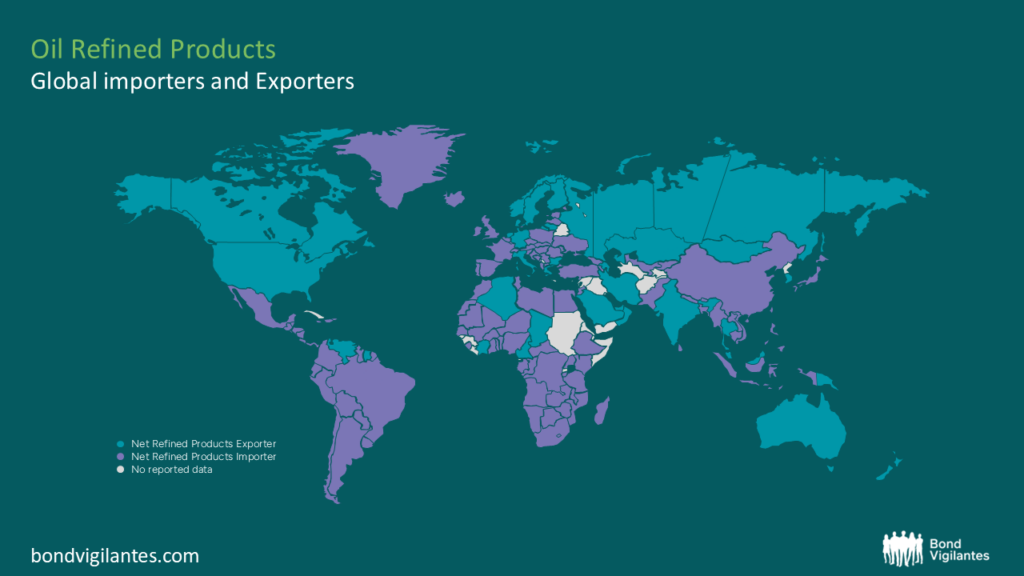
- Oil exporters’ refining divide: Not all oil-exporting countries benefit equally from higher crude prices, as the impact hinges on refining capacity and crack spreads. The World Bank notes that Mexico and Ecuador, despite being net crude exporters, face US$ 25bn and US$ 6.6bn annual oil trade deficits respectively due to insufficient refining capacity. Diesel cracks have risen 30% y/y, while jet cracks spiked to record highs in March, favoring full-chain exporters like Saudi Arabia and Russia. The divergence is evident in sovereign bond performance: Nigeria, Angola, and Ecuador’s bonds have outperformed since the Iran conflict began, while Mexico’s 10Y spread to USTs has widened 15bps. The cross-asset linkage is clear in FX: the Russian ruble and Saudi riyal have appreciated 4-5% against the USD since March, while the Mexican peso has depreciated 2.3% (Bond Vigilantes).
- [DIVERGENCE: BoJ’s inflation targeting vs. yen stability]: BoJ Governor Kazuo Ueda argues that Japan’s inflation has shifted to a "demand-driven" regime, justifying a gradual exit from ultra-loose policy. The BoJ’s April *Outlook Report* revised core CPI forecasts to 2.3% for FY2026 (up from 1.9%), while Tankan survey data shows 70% of firms planning wage hikes in 2027. Ueda’s hawkish pivot could trigger a 10-15bps hike in the short-term rate target as early as July, steepening the JGB yield curve and rallying the yen to 135-140 USD/JPY. However, Goldman Sachs’ *Japan Economics Weekly* counters that a premature tightening could trigger a "reverse currency war," with a 10% JPY depreciation adding 0.5-0.7pp to core CPI. GS’s model flags Japan’s ¥400T net external liabilities as a constraint on aggressive tightening, suggesting USD/JPY could test 155-160 if the BoJ delays (BIS Publications).
- Canada’s housing as systemic risk: The Bank of Canada’s *Financial Stability Report* (May 2026) warns that household debt and housing imbalances have evolved into a structural vulnerability. BoC data shows 35% of Canadian mortgages will reset to higher rates by 2027, with debt servicing ratios (DSRs) exceeding 40% for 12% of households (up from 5% in 2021). Investor-owned condos in Toronto have surged 20% y/y, with 40% of new mortgages in 2025 issued to investors. The BoC may introduce macroprudential tools (e.g., debt-to-income caps) by Q4 2026, cooling housing-related credit growth by 10-15%. This would weigh on Canadian banks’ net interest margins (TD, RY) by 20-30bps and could trigger a 5-7% correction in REITs (CAR.UN, Riocan). The CAD is expected to underperform G10 peers on policy divergence, with 2Y OIS spreads to USTs already 15bps wider since the report’s release (BIS Publications).
What to Watch
Today’s US May jobs report (consensus: +185k payrolls, 3.9% unemployment, 3.9% y/y average hourly earnings) is the critical catalyst, with a print above +220k likely to push US 10Y yields back to 4.55% resistance and pressure EM FX (e.g., USD/MXN 17.20). The Bank of Canada’s intraday liquidity buffer data (12% of daily payment value) will be scrutinized for signs of structural decline post-Agorá, with a drop below 10% potentially widening the CAD OIS/GC repo spread by 25-50bps. ECB Executive Board member Piero Cipollone speaks at 14:00 CET, with markets watching for digital euro pilot details; a mention of "2027 launch" could steepen EU-US 2Y swaps by 10bps. In Asia, Japan’s final Q1 GDP (consensus: -0.5% q/q) and BoJ Governor Ueda’s press conference (08:30 CET) will test the hawkish pivot thesis, with USD/JPY 155.00 the key level—break above targets 158.00, while a hold below could trigger a squeeze to 152.00. The open question: will the Fed’s July "no change" pricing (92% probability) survive a strong jobs report, or will the market reprice a 25bps hike by September?
