EU Midday Digest - 04 Jun 2026
AI-generated midday market digest from curated financial newsflow.
SpaceX’s $1.77tn IPO valuation forces markets to price AI capex risks against geopolitical liquidity shocks.
Overnight & European Session
Global risk assets opened on the defensive after Broadcom’s Q2 revenue miss dragged Nasdaq futures down 1.2% in Asia, while SpaceX’s $1.77tn IPO filing sparked a 0.8% rally in European tech (SX8E) on AI infrastructure optimism. The dollar firmed (DXY +0.3%) as US-Iran tensions escalated, pushing Brent crude to $96.64/bbl and gold to US$4,493/oz. JGB yields rose 3bps to 0.98% after the MOF’s liquidity-enhancement auction revealed weak foreign demand, while EUR/USD held 1.1633 despite Eurozone services PMI revisions. The divergence between Asia’s tech-led sell-off (Nikkei -1.4%) and Europe’s defensive rotation (Stoxx 600 +0.2%) reflects positioning for a potential Fed hawkish hold in June, with Polymarket pricing 98% odds of no change.
Key Themes Today
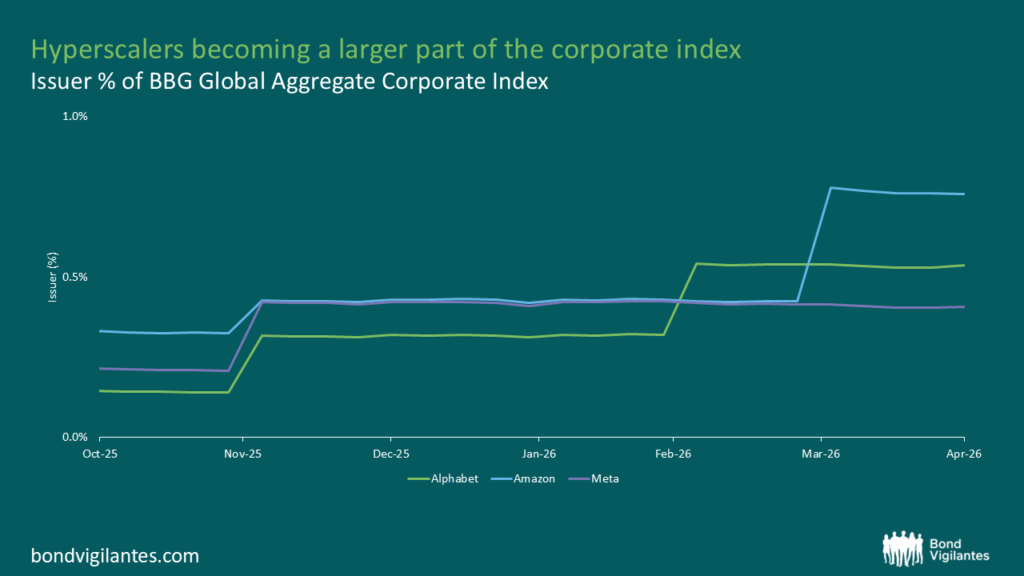
- Big Tech’s debt binge mispriced as AI capex cycle matures: Bond Vigilantes argues that Alphabet, Amazon, and Meta’s $150bn+ debt issuance is not a credit risk but a structural shift driven by AI capex, with EBITDA margins (40-45%) justifying leverage. However, the market’s technical absorption limits—portfolio caps at 1-3% per issuer—are forcing spreads 20-30bps wider (e.g., 5Y Meta bonds at +85bps vs. industrials). This creates a "beautiful borrowing" window for high-grade credit, but the divergence between equity valuations (ARM at 65x P/E) and bond spreads suggests AI monetization risks are underpriced. Position for spread compression in 3-7Y maturities as dedicated Big Tech bond funds launch in H2 2026.
- JGB liquidity squeeze tests BoJ’s "soft YCC exit": The MOF’s June 4 auction revealed a bifurcated market: domestic banks absorbed 68% of ¥1.2tn issuance, while foreign accounts’ allocation collapsed to 8% (vs. 22% in Q1). The 1.5bps tail (difference between average and cut-off yields) signals stress, with 10Y JGB yields clearing at 0.98%—2bps above pre-auction screens. Ashenden’s regime-matching model suggests this mirrors the 2023 "stealth tapering" playbook, where the BoJ widened the YCC band before abandoning it. If the BoJ adopts a yield range (e.g., 0.5-1.5% for 10Y), expect 5s30s to steepen from +65bps to +90bps, with JPY swaps repricing 20bps higher. Watch for MOF intervention if gross reserves dip below $110bn.
- EM FX divergence widens on policy vs. growth trade-offs: The Turkish lira (USD/TRY at 32.50) and Indian rupee (USD/INR at 83.50) are moving in opposite directions despite similar inflation pressures. The TCMB’s hawkish hold (50% policy rate) contrasts with the RBI’s FX intervention ($22bn reserves spent YTD), creating a "carry vs. stability" trade. Bloomberg Economics notes that Turkey’s 28.5% 12-month inflation expectations (vs. RBI’s 5.1% target) justify the divergence, but the risk is a TRY overshoot if the TCMB delays cuts. Meanwhile, INR forwards (12M at 84.50) are pricing in oil at $100/bbl, suggesting a break above 84.00 could trigger a sharp sell-off. Position for TRY strength (target 31.00) and INR weakness (hedge via NDFs) as the Fed’s QT program extends.
- [DIVERGENCE: AI growth vs. execution risks]: SpaceX’s $1.77tn IPO filing bets on exponential growth in space/satellite markets, while Broadcom’s Q2 miss exposes fragility in AI-driven revenue. CNBC highlights that SpaceX’s valuation assumes rapid Starship commercialization, whereas Broadcom’s unchanged AI chip forecast—despite weak software sales—suggests monetization may lag. Goldman Sachs’ CTA model shows $2.1bn of net selling in AVGO over the past week, with leveraged funds reducing NVDA and AMD exposure by 8%. The tension could trigger a sectoral rotation: "defensive" AI plays (e.g., MSFT, GOOGL) may outperform, while speculative growth names (e.g., space, early-stage AI) face volatility. The key question: Can AI capex sustain Big Tech’s debt issuance without margin compression?
- UK regulatory overhaul tightens bank funding costs: The Bank of England’s taxonomy v1.3.1 introduces 47 new data elements (e.g., daily liquidity buffers by currency), effective September 2026, citing a 12% under-reporting gap in intraday liquidity metrics. Bond Beat notes that UK-listed banks (LLOY, BARCl) will face a 3-5bps increase in funding costs, steepening the 2s5s curve. The BoE’s focus on sectoral LTV distributions (38% of new mortgages above 80% LTV) also pressures RMBS spreads, with housing-exposed equities (TW., PSN) at risk if a sectoral buffer hike is signaled in November. This regulatory drag contrasts with the EU’s delayed Basel 3.1 rules, creating a competitive disadvantage for UK banks. Short UK financials (XLF equivalent) and long EUR/GBP (target 0.8650) on relative policy divergence.
What to Watch
Intraday catalysts include the RBA’s Senate testimony (09:30 GMT), where Governor Bullock’s hawkish caution could keep August hike odds at 50% despite soft Q1 GDP. Watch AUD/USD 0.6700 resistance—a break confirms the "hawkish hold" narrative and pressures AUD/JPY shorts. US ADP payrolls (12:15 GMT) are expected at 150k (vs. 122k prior), with a print above 170k likely to push 10Y UST yields toward 4.55% and test gold’s $4,500/oz support. The BoJ’s Suzuki speaks at 23:00 GMT; any hint of a July hike (currently 45% priced) could send USD/JPY to 158.00. Divergence alert: Citi’s flow desk sees $3.4bn in put options open interest at 5,200 on the Nasdaq 100—a break below could trigger algorithmic selling into the June FOMC. Open question: Will the Fed’s QT extension beyond September force a repricing of Big Tech’s debt issuance cycle?
