EU Close Digest - 15 May 2026
AI-generated close market digest from curated financial newsflow.
US 30-year Treasury yield breached 5.11%, the highest since 2006, as oil-driven inflation fears force markets to price out Fed cuts through 2026.
US Session Open & European Close
The US session opened sharply lower and extended Europe’s morning sell-off, with the S&P 500 shedding 0.87% to 7,436 and the Nasdaq 100 dropping 1.05% to 29,270. Breadth was decisively negative: only 3 of 11 S&P sectors closed in the green (utilities +0.2%, healthcare +0.1%), while energy (-2.3%) and financials (-1.8%) led decliners. The move confirmed the European close’s risk-off tone—Euro Stoxx 50 fell 0.61% to 5,825—as Brent crude settled at US$ 108.99 (+3.09%) and the DXY index climbed 0.41% to 99.00. Intraday, the 10-year UST yield spiked 12 bps to 4.58%, the 30-year jumped 10 bps to 5.11%, and the VIX rose 4.35% to 18.01, signaling a regime shift from “soft landing” to “higher-for-longer” repricing. Sector rotation was pronounced: growth stocks (NDX -1.05%) underperformed value (Russell 1000 Value -0.6%), while small-caps (IWM -1.2%) lagged large-caps, reflecting duration sensitivity and rising term premia.
Analyst Consensus
- Bond Yields & Inflation Regime Shift: Both Bloomberg and the Financial Times argue that the bond sell-off is not a technical correction but a structural repricing driven by war-induced oil inflation. Bloomberg reports 10-year UST yields surged 12 bps to 4.78% intraday, while front-month Brent futures settled at US$ 112.40 (+3.2%). The FT adds that 5-year US inflation swaps rose to 2.85%, the highest since 2023, as traders price in a “second wave” of inflation. Goldman Sachs’ CTA model shows systematic funds shorting US$ 120 billion of 10-year UST futures, the largest net short since October 2023. The implication is a terminal rate above 5% in the US and above 4% in the euro area, triggering a second wave of duration unwinds by real-money funds and CTAs, accelerating the move into cash and short-dated paper.
- DIVERGENCE: Fed Policy Under Warsh – SocGen vs. Market Consensus: SocGen’s rates team warns that new Fed Chair Kevin Warsh’s hawkish bias risks a policy error if he over-tightens into a slowing economy, citing the 10-year UST yield surging 45 bps in May to 4.85% and the MOVE index hitting 135. They recommend fading the UST selloff, targeting 4.50% on the 10-year by Q3. Conversely, Goldman Sachs and BofA’s fund manager survey (68% expect no cuts in 2026) argue Warsh’s “Volcker-lite” approach will keep the Fed on hold until core PCE falls below 2.5%, with OIS markets pricing only 50 bps of easing by year-end. The divergence implies a “higher-for-longer” consensus may be overestimating the Fed’s tolerance for inflation, creating binary risk around the June SEP if core PCE (currently 3.1%) fails to cool.
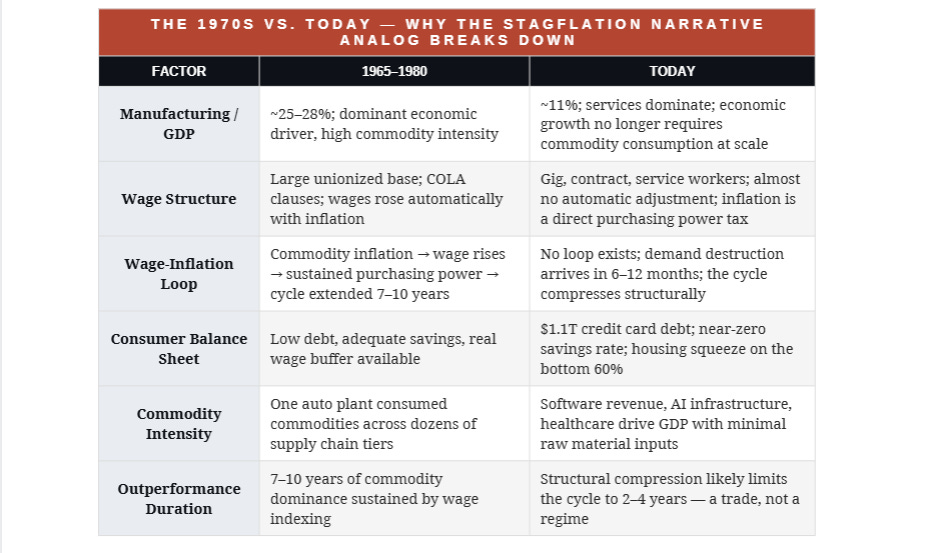
- Cross-Asset Linkage – Oil, Rates, and Equity Valuation: The EIA’s Short-Term Energy Outlook projects global oil inventories will draw by 1.2 mb/d in Q3 2026, while Chevron’s Richmond refinery runs at 92% utilization (vs. 85% 5-year average). Bloomberg notes US diesel at US$ 5.03/gallon, the highest since December 2022, and hedge funds have built the largest net-long position in Brent futures since 2018 (+420k contracts). This oil shock is feeding into break-evens and TIPS spreads, with 5-year US inflation swaps at 2.85%. The cross-asset implication is a stagflationary backdrop that penalizes duration and growth equities: Nomura’s cross-asset strategist Charlie McElligott warns the S&P 500’s 200-day moving average (4,820) is now key support, with a break below activating CTA de-leveraging programs that could sell US$ 80–100 billion of global equities in a single week.
- Contrarian Call – AI Capex as a Cyclical, Not Structural, Driver: Ashenden’s PiQ Suite challenges the narrative that AI capex is a structural growth driver, arguing that April’s industrial production rebound (+1.2% MoM, strongest since March 2025) is a cyclical restocking cycle, not a secular AI boom. Goldman Sachs’ analysis shows business equipment spending jumped +1.48% MoM (highest since March 2025) and +6.01% YoY, but motor vehicles/parts (+3.7% MoM) led the gain, while y/y auto production remains -2.1%. The contrarian implication is that industrials (XLI) and capital goods (BA, CAT, HON) may outperform into Q3, but the “soft landing” narrative is at risk if capex feeds into core services inflation, forcing the Fed to delay cuts. Watch for upward revisions to GDPNow and Atlanta Fed estimates as a near-term catalyst.
- Geopolitical Risk – US-China Détente Fails to Stabilize Markets: InvestingLive and the Financial Times report that the Trump-Xi summit established a “longer-term operating framework” focused on energy security, but Taiwan was not substantively discussed, and Trump declined to reaffirm defense commitments. The lack of concrete trade agreements—despite Trump’s claims of 200 Boeing jets and increased oil purchases—left markets pricing in sustained geopolitical volatility premiums in semiconductors (SOX) and defense stocks (ITA). The divergence between US political messaging and China’s official readout (which omitted all energy and aerospace deals) implies execution risk for US exporters (BA, XOM) and a potential re-escalation of cross-strait tensions, keeping USD/CNH bid at 6.8415 and pressuring EM equities (EEM -1.5%).
Tomorrow's Setup
Asia opens with a heavy macro calendar: Japan’s Q1 GDP (consensus +0.4% QoQ, +1.6% annualized) and April trade balance (¥-500bn est.) will test the BoJ’s hawkish hold, with USD/JPY at 158.69 and 10-year JGB yields at 1.02%. Australia’s April employment report (consensus +25k jobs, unemployment 4.0%) follows the RBA’s 25bps hike to 4.35%, with AUD/USD at 0.6780 and 3-year ACGB yields at 4.35%. In Europe, the UK’s April CPI (consensus 3.1% YoY, core 4.2%) and March unemployment (3.9% est.) will shape BoE rate-cut expectations, with 10-year gilt yields at 5.14% and GBP/USD at 1.3324. The US session brings April retail sales (consensus +0.4% MoM) and May Empire State manufacturing (15.4 est.), with the 10-year UST yield at 4.58% and S&P 500 futures -0.3%. Key risk events include Fed Chair Warsh’s first public remarks (14:00 ET) and earnings from Applied Materials (AMAT, after-hours) and RBC Bearings (RBC, pre-market). The open question: Will Warsh’s speech validate the market’s hawkish repricing, or will he signal a “conditional pause” that triggers a bond rally and equity rebound?
