EU Midday Digest - 15 May 2026
AI-generated midday market digest from curated financial newsflow.
10-year UST yield breaks 4.54%, forcing equities to reprice as bond-stock yield spread inverts for first time since 2003.
Overnight & European Session
Global risk assets opened on the defensive after the 10-year UST yield surged 8 bps overnight to 4.54%—a one-year high—on the back of Iran’s refusal to reopen the Strait of Hormuz and China’s controlled yuan depreciation (USD/CNY fix at 6.8415, 439 pips above estimate). The move triggered a classic “sell everything” cascade: KOSPI (-1.99%), Brent (+2.69% to US$ 108.56), and DXY (+0.24%) all repriced higher, while gold (-2.57%) and US equity futures (S&P 500 -0.77% at 7,501) underperformed. European equities followed suit, with Euro Stoxx 5,833 (-0.48%) and gilts selling off as UK political uncertainty compounded the bond rout. The divergence between Asia’s tech-heavy sell-off (Nikkei 225 -1.99%) and Europe’s more muted reaction reflects regional sensitivity to oil-driven inflation: Japan’s wholesale inflation hit 4.9% YoY, while Eurozone services PMI remains sticky at 53.5.
Key Themes Today
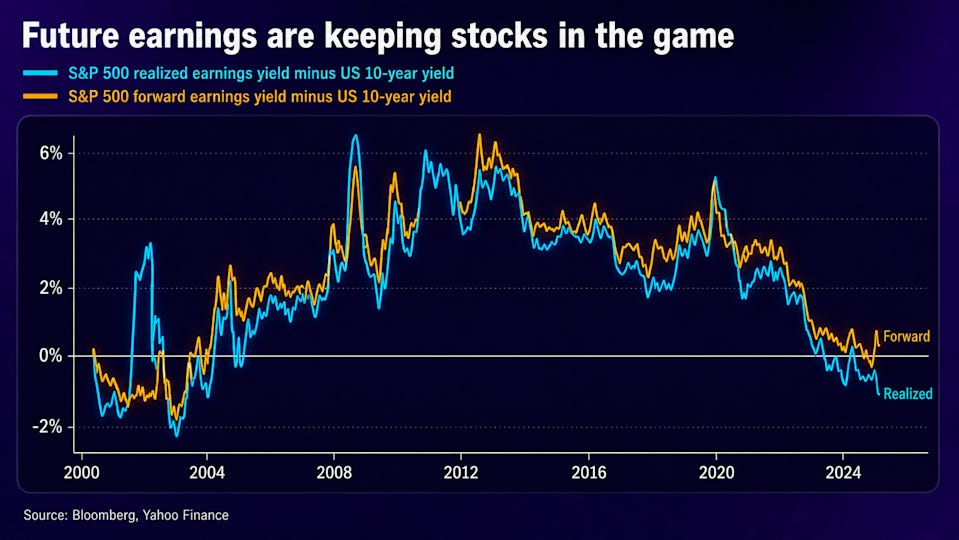
- Bond-stock yield inversion: The 10-year UST yield (~4.5%) has eclipsed the S&P 500’s realized earnings yield (3.4%), creating a -110bps spread for the first time since 2003 (The Bond Beat). Forward earnings yields (~4.5%) only match Treasuries if profit growth materializes—a tenuous assumption amid margin pressures (e.g., Cisco’s 17% post-earnings surge tied to 4,000 layoffs, Reuters). The inversion forces a repricing of equity risk premiums, particularly for rate-sensitive sectors (tech, real estate), as bonds offer safer yield without earnings execution risk. A sustained break above 4.6% on the 10-year would accelerate the rotation out of growth equities and into short-duration credit or cash.
- Fed hike risks underpriced: BAML’s “Liquid Insight” warns the market is dangerously complacent about Fed hike risks, pricing zero probability of a hike despite a 3.64% effective funds rate below headline inflation (ING Rates Spark). The 2-year yield’s inversion relative to Fed funds signals tightening is overdue, while BMO counters that core inflation pressures remain muted (two-thirds of April’s PPI surge came from trade services margins, not core-PCE inputs). The divergence hinges on whether inflation is broadening (BAML’s view, favoring front-end steepeners) or transitory (BMO’s view, supporting “higher for longer” but stable rates). A hike would shock equities; a pause could extend the AI-driven rally.
- Stagflationary signals flashing: The Misery Index (CPI + unemployment) hit a 3-year high of 7.5% in April, with PPI at 6%+ and unemployment ticking up to 3.9% (Apollo, @lizannsonders). Non-energy commodities (Bloomberg Index) are at record highs, while Japan’s wholesale inflation (4.9% YoY) and India’s fuel price hikes (+3%) confirm cost-push pressures. The Fed may tolerate higher unemployment to tame inflation, delaying cuts and pressuring cyclicals (XLE, XLI). Gold (GLD) and TIPS are likely to outperform as stagflation hedges, while growth equities (ARKK) face multiple compression.
- Divergence: RBA hikes vs. BOJ’s caution: The RBA hiked 25bps to 4.35%—its first move since February 2026—citing sticky inflation (Q1 CPI 3.8% YoY) and wage growth (4.1% YoY), while the BOJ held at 0.10% despite yen-driven inflation (CGPI 4.9% YoY). The RBA’s forward guidance hardened, with markets now pricing a 60% chance of another hike by August (AUD OIS), while the BOJ’s June hike probability sits at 65% (Reuters poll). The divergence creates cross-asset volatility: AUD/USD could test 0.6800 on carry trades, while USD/JPY may breach 160 if the BOJ delays. Short-end AUD bonds (3Y ACGBs) are likely to underperform, while JGBs face term premium risks.
- Credit stress in mortgages: Goldman Sachs flagged a “troubling uptick” in mortgage delinquencies, while the 30-year UST auction tailed at 5%+ (MS Global Macro). The 30-year mortgage rate (~7.2%) nears 2000s highs, threatening the Fed’s “higher for longer” regime. If delinquencies spread (e.g., subprime auto, credit cards), the Fed may face pressure to cut rates before inflation is fully controlled, creating a “stop-go” policy trap. Watch regional bank stocks (KRE) and high-yield spreads (HYG) for early warning signs.
What to Watch
Intraday catalysts include the May Empire Manufacturing Index (consensus: -10.0, prior: -14.3) at 8:30 ET—any upside surprise would reinforce the “no Fed cuts” narrative and pressure 10Y UST 4.54% resistance. Fed Vice Chair Barr speaks at 10:00 ET; his focus on “liquidity resilience” (SRF as a permanent backstop) could ease repo market tail risks but may not offset hawkish inflation rhetoric. Earnings from RBC Bearings (pre-market) and Applied Materials (after-hours) will test the AI capex thesis: a miss on guidance could trigger a tech sector rotation. The key level to watch is 4.60% on the 10-year UST—a clean break would confirm the reflation trade and force equities to reprice lower. Divergence alert: BAML expects a hike by September, while Goldman’s CTA model shows systematic trend-followers max short in 2Y Treasuries. Open question: Will the Fed prioritize financial stability (Barr’s view) or inflation (Bowman’s hawkishness) if mortgage delinquencies rise?
