EU Close Digest - 13 May 2026
AI-generated close market digest from curated financial newsflow.
The 10-year Treasury yield surge to 4.49% pressures S&P 500 valuations amid inflation fears.
US Session Open & European Close
The S&P 500 opened slightly higher at 7,416 (+0.20%) despite elevated Treasury yields, while the Nasdaq 100 gained 0.51% to 29,212, reflecting resilience in tech after initial rate-driven weakness. European equities closed positively with the Euro Stoxx up 0.64% at 5,845, supported by defensive strength and fiscal stability rhetoric from Bundesbank officials. The US session saw early pressure on growth stocks as the 10-year yield jumped 58 bps to 4.49%, but a late-day stabilization in tech—led by resilient semiconductor names like Nvidia—offset declines in rate-sensitive sectors. This divergence suggests investors are differentiating between high-quality AI beneficiaries and broader rate-exposed equities.
Analyst Consensus
- Inflation & Rates: Multiple sources confirm a hawkish repricing in yields following hotter-than-expected PPI and CPI prints: the April core PPI rose 1.0% m/m and 5.2% y/y, while headline CPI hit a 3.8% annual increase, the highest since May 2023. Bloomberg reports the 10-year Treasury yield climbed to 4.75% intraday, and market pricing now reflects a 70% probability of at least one Fed hike by June 2026, with a 38% chance of two hikes. Both Neil Sethi and CNBC highlight that elevated energy and shelter costs—shelter up 0.6% m/m—are driving persistent inflation, reducing odds of any rate cut before 2027. This reinforces a “higher-for-longer” rate environment, pressuring duration-sensitive assets.
- Geopolitical Divergence: While Neil Sethi and CNBC emphasize that Trump’s visit to Beijing could extend the US-China trade truce and benefit tech and agriculture stocks, Yahoo Finance notes that Nvidia and chip peers showed resilience—trading within a 0.3% band—suggesting contained trade risk for semiconductors. In contrast, JPMorgan warns of regulatory and trade friction risks from the US-China agenda, citing a 1.2% drop in US oil stocks despite flat crude prices. This split implies markets are pricing in selective exposure: tech supply chains may be stabilized, but energy faces domestic policy overhangs.
- Cross-Asset Linkages: Rising yields and dollar strength are reshaping cross-asset flows: the DXY rose 0.22% to 99, supporting higher Treasury yields and pressuring gold, which gained only modestly to US$4,696 despite inflation concerns. Bloomberg notes short-duration Treasury ETFs attracted $4.2bn in inflows over five days, while long-duration funds saw $2.8bn in outflows, confirming a flight to yield without duration risk. Meanwhile, the EIA’s forecast of solar overtaking coal in ERCOT by 2026—78 BkWh vs. 60 BkWh—signals structural shifts in energy, favoring solar equities and storage solutions over coal-heavy utilities like Vistra Corp (VST).
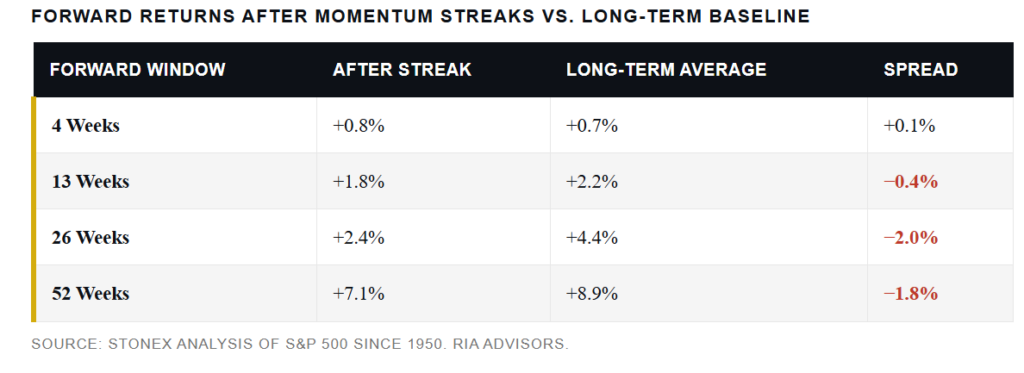
- Contrarian Call: Lance Roberts argues the S&P 500’s seven-week winning streak creates overbought conditions, with historical precedent showing an average 4-week forward return of just +0.1% after similar momentum extremes—well below the baseline +0.7%. Despite strong earnings in mega-cap tech, Roberts warns the rally is narrow and unsustainable amid weak consumer health, rising credit usage, and fast food underperformance—McDonald’s down 7% YTD. This setup, he cautions, “doesn’t usually give a polite warning” when it breaks, suggesting a shallow pullback may offer a tactical entry rather than a crash signal.
- Central Bank & Policy Shifts: The confirmation of Kevin Warsh as Fed Chair—priced in by markets per Bloomberg—is cementing a hawkish policy trajectory, with Polymarket showing 85% odds of no rate cut by September 2026. Simultaneously, the BIS highlights structural shifts in monetary transmission: Burkhard Balz notes euro area cash circulation fell 12% YoY in Q1 2026, accelerating the shift to digital payments and potentially lowering short-term STIR rates. Meanwhile, the SNB’s upcoming auction changes and new bond issues may influence Swiss franc liquidity, while IMF SDDS Plus data is deemed low-relevance (0.2/10) for real-time decisions, underscoring the need for alternative data in policy assessment.
Tomorrow's Setup
Asian markets may open mixed as investors assess whether China’s summit with Trump yields concrete trade progress, while Japanese yields could react to USD/JPY at 157.82 and BOJ commentary. No consensus level identified for US equity futures, but key support remains at S&P 500 7,350 and resistance at 7,450. Attention turns to upcoming Fed speeches and potential SNB auction changes, which may influence short-end rates. The macro calendar is light, but positioning remains skewed long mega-cap tech, with Polymarket pricing near-zero chance of a Fed cut before 2027. The open question: will AI-driven earnings resilience offset broader consumer weakness and keep the rally intact?
