EU Midday Digest - 13 May 2026
AI-generated midday market digest from curated financial newsflow.
US 10-year yields broke 4.45%, confirming the Fed will hike, not cut, through 2027.
Overnight & European Session
European equities opened higher, with the Euro Stoxx up 0.32% to 5,827, defying elevated bond yields and oil prices. The US 10-year Treasury yield surged 1.20 bps to 4.46%, its highest since 2023, after April CPI came in at 3.8% y/y—above consensus and reinforcing hawkish Fed pricing. The DXY strengthened to 99 (+0.25%), pressuring GBP/USD down 0.73% to 1.3505, as political uncertainty around UK PM Starmer weighed. Brent crude held near 107.61 despite IEA warnings of inventory drawdowns, while gold rose 0.69% to US$4,710 on safe-haven demand. Asian markets diverged, with the Nikkei 225 gaining 0.84% on tech strength, while Chinese AI developers rallied on speculation of eased chip controls.
Key Themes Today
- Rates & Inflation: The Fed is now fully priced to hold rates higher for longer, with markets assigning a 93% probability that the lower bound stays above 0.5% through 2027 (Polymarket). April CPI at 3.8% y/y—above the 3.7% consensus—and broadening inflation in food, apparel, and housing services signal the Fed may add a hike rather than consider a cut (CNBC). Real yields are rising, with the 2-year UST at 3.60% (+0.08%), amplifying capital outflows from EM and pressuring rate-sensitive sectors. This re-pricing invalidates the "soft landing" narrative, favoring short-duration bonds and dollar-denominated assets. The shift is confirmed by Goldman Sachs and JPMorgan, both noting persistent oil-driven inflation could delay any policy pivot.
- US-China Tech Diplomacy: Nvidia CEO Jensen Huang’s surprise inclusion in Trump’s China delegation signals a potential softening of semiconductor export controls, lifting Chinese AI developers and US chipmakers (Zack Eiseman, CNBC). Traders speculate China could gain access to H200 chips, though Alibaba’s core profit plunged 84% y/y, exposing weak earnings quality beneath AI-driven top-line growth (CNBC). While the move may ease tensions, the ad-hoc nature of the invitation adds policy uncertainty, with Micron and Intel rebounding on sentiment rather than fundamentals (Yahoo Finance). This creates a narrow window for positioning in semis, but any reversal could trigger sharp sell-offs. The theme is reinforced by Investing.com, which notes rising futures ahead of the summit.
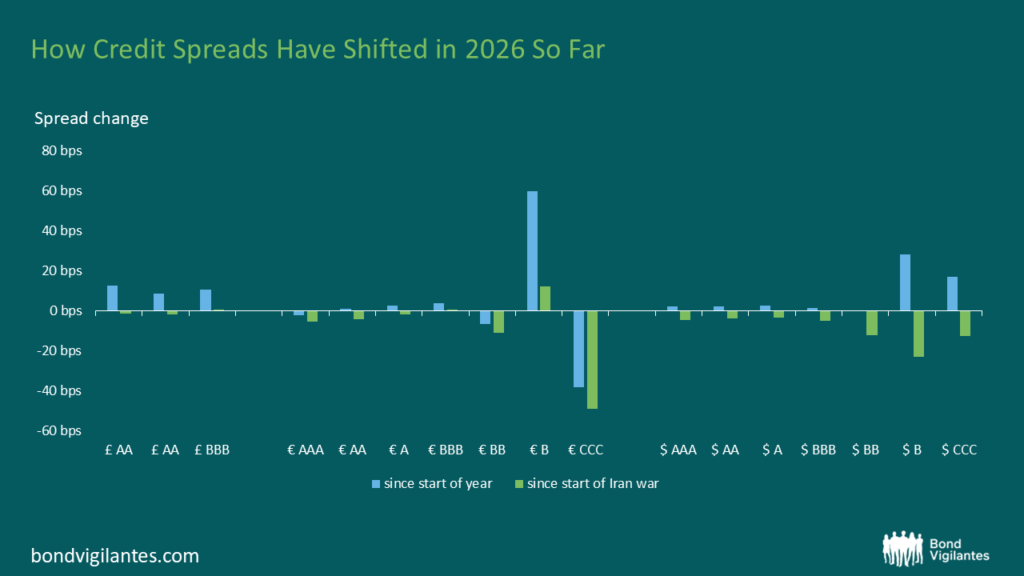
- Credit Market Divergence: Euro single-B high-yield spreads have widened by 60bps since January—60bps more than any other credit tier—while US dollar-denominated high yield tightens, suggesting a regional stress signal (Bond Vigilantes). Despite strong flows into high-yield funds and tight equity volatility (VIX at 17.95%), single-Bs are pricing in rising default risks in peripheral Europe, possibly linked to energy cost shocks and stagflation (ECB’s Rehn). This divergence implies the broader credit market may be complacent, with US$2tn in S&P 500 call options reflecting extreme upside positioning (Off The Charts). Investors should monitor for contagion; if single-B stress spreads, it could trigger a risk-off move in European equities and sovereign debt.
- Geopolitical Energy Reconfiguration: Iran is bypassing the Strait of Hormuz via overland oil and LNG deals with Iraq and Pakistan, reducing maritime exposure but tightening supply of oil-derived construction materials (Zack Eiseman). This structural shift sustains oil-price volatility, with European jet fuel stocks projected to empty by mid-summer (Off The Charts). While physical supply strains mount, financial markets remain complacent—Diamondback Energy is hedging WTI-Brent differentials at minus $42/barrel, signaling producer concern (Off The Charts). The EIA and IEA both warn of inventory drawdowns, yet Brent remains range-bound. X argues this underprices supply disruption risk, while Y (Bloomberg) notes China’s inventory drawdowns may temporarily offset tightness.
- European Integration & Fragmentation: ECB’s Elderson stresses that EU capital market fragmentation—only 18% of bank assets cross-border—undermines monetary transmission and climate financing, with a €400bn annual green investment shortfall (ECB). Despite this, political will lags: only 40% of Capital Markets Union reforms are adopted (ECB), and fintech adoption varies from 80% in France to under 20% in Greece (ECB Digital Euro Report). This divergence supports peripheral debt underperformance and limits EUR/USD upside, even as the dollar strengthens on Fed policy. SNB research adds that USD dominance in 88% of FX trades creates self-reinforcing volatility, making EUR a structural underperformer. Investors should favor core European credit and short-duration CHF over pan-EU equity exposure.
What to Watch
Cisco’s Q3 earnings call at 4:30 PM ET is a key catalyst for tech sentiment, particularly on AI infrastructure demand (Nasdaq). A clean break above 4.45% in the 10Y UST would confirm the reflation trade and pressure growth equities, while a reversal below 4.35% could spark a short-covering rally in rate-sensitive names. Polymarket shows 84% odds the Fed won’t cut by September 2026, aligning with CNBC’s view that a hike is more likely. Morgan Stanley’s elevated S&P 500 target is met with skepticism (source score 2.5/10), while Mike Wilson argues risks are already priced in. Will the credit canary’s warning precede a broader market correction, or will equities continue to ignore it?
