EU Close Digest – 08 May 2026
AI-generated close market digest from curated financial newsflow.
Brent crude rose to US$ 102.02 bbl, pushing the S&P 500 to 7,390 as “Trump‑backed” buying outpaced European weakness.
US Session Open & European Close
The S&P 500 opened higher, climbing 0.73 % to 7,390 while the Nasdaq 100 surged 1.75 % to 29,065, reflecting strong demand for large‑cap tech and consumer‑discretionary names. Breadth was mixed: the S&P 500 fell 0.4 % on the day but the Nasdaq held near flat and the SOX slipped 2.7 %, indicating that mega‑caps were sustaining the rally while small‑cap participation weakened. In Europe, the STOXX 600 fell 1.11 % to 5,906, with the DAX down 0.9 % and the FTSE 100 off 0.2 % for the week, underscoring the divergence highlighted by Neil Sethi. The US open confirmed the “Trump‑effect” narrative—Trump’s tweet about an “all‑time high” coincided with futures hitting record levels—while European markets remained under pressure from weaker earnings outlooks and political uncertainty.
Analyst Consensus
- Equity Momentum – “Trump‑backed” Rally: Both Neil Sethi and the broader market snapshot point to a politically‑driven bias in U.S. equities. Sethi notes the S&P 500 is on track for a sixth straight week of gains—the longest streak since October 2024—and cites Trump’s tweet as a catalyst for continued buying. The live market data, showing the index up 0.73 % at 7,390, validates this thesis. The implication is that as long as the narrative of a “Trump‑backed” market persists, large‑cap allocations will stay robust, supporting the index through near‑term geopolitical shocks such as the Strait of Hormuz tension.
- Labor Market Divergence – Credit vs. Temporary Staffing: Neil Sethi highlights a 5.8 % SAAR rise in total non‑mortgage consumer credit to US$ 24.9 bn, well above the Bloomberg consensus of US$ 13.7 bn, suggesting household confidence. In contrast, Lance Roberts flags a decline in temporary‑help employment to recession‑level ratios, a historically bearish signal. The two views diverge: Sethi sees credit growth as a bullish driver for consumer‑discretionary stocks, while Roberts warns that weakening temporary‑staffing could presage a broader labor slowdown, prompting a tilt toward defensive assets. Investors must weigh the short‑term credit‑driven optimism against the longer‑term staffing‑trend warning.
- Rate‑Sensitive Sectors and Yield Dynamics: The Fed’s March consumer‑credit report and April payrolls (115 k above forecast, unemployment steady at 4.3 %) give the central bank room to pause tightening, according to Sethi. This dovish backdrop helped keep the 2‑year Treasury at 3.60 % (down 8 bps) and the 10‑year at 4.36 % (down 68 bps). At the same time, higher oil prices from Strait of Hormuz tensions lifted yields, reinforcing the link between commodity shocks and bond markets noted by Roberto Scholtes (Singular Bank). The combined effect supports equity valuations in rate‑sensitive sectors while keeping inflation‑linked spreads modest.
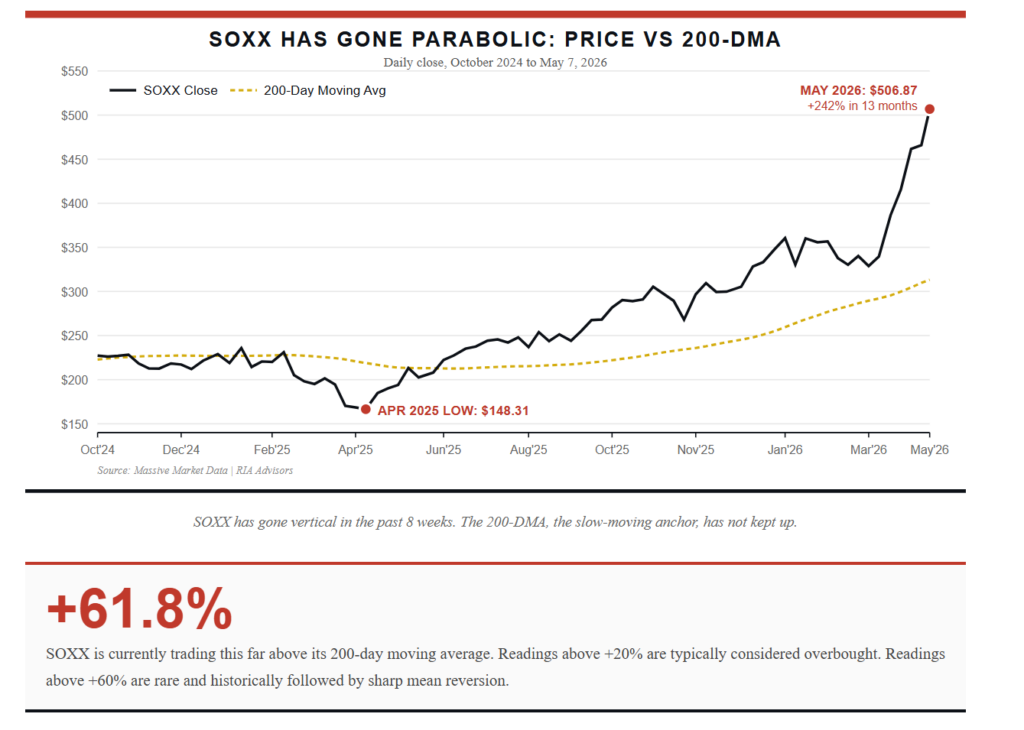
- Semiconductor Over‑extension – Contrarian Call: Lance Roberts warns that the semiconductor rally is “parabolic” and likely due for a sharp correction. He cites SOXX trading 62 % above its 200‑day moving average and a 242 % gain from the April 2025 low, with extreme dispersion among constituents (e.g., Micron +1,000 %). The contrarian view suggests trimming oversized semiconductor exposure and using the 50‑day moving average (~$377) as a stop level. This call contrasts with the broader market’s tech‑driven upside and highlights a specific risk for investors heavily weighted in high‑beta small‑cap tech.
- Commodity‑Price Feedback Loop – Dollar Strengthening: Lance Roberts argues that higher commodity prices reinforce the U.S. dollar’s dominance, as >90 % of commodities are dollar‑denominated. COFER data show the dollar holding ~57‑58 % of global FX reserves, and past shocks have driven central banks to increase dollar holdings. The current rise in Brent to US$ 102.02 (+1.96 %) feeds dollar inflows, supporting the DXY at 98 (down 0.29 %). This feedback loop limits the upside of a “de‑dollarisation” narrative and suggests that commodity‑driven risk‑on moves will likely be offset by a stronger dollar, pressuring emerging‑market equities.
Tomorrow's Setup
Asian markets are expected to open lower after the Strait of Hormuz flare‑up, with Japanese equities under pressure from BOJ tightening expectations (74 % probability of a hike, rising to 86 % by July). Key U.S. data include the release of the ISM Services Employment Index (consensus 48.0 %) and the Fed’s Beige Book, which will test whether the labor market remains tight enough to keep rate expectations subdued. The Euro‑dollar pair is likely to test the 1.1800 level; a break above could reinforce the dollar’s safe‑haven appeal, while a dip below 1.1750 would aid the euro and European equities. The primary risk is a further escalation in the Hormuz dispute, which could push Brent above US$ 105 bbl and trigger a rapid yield‑curve steepening. The market’s open question heading into tomorrow is whether the “Trump‑backed” equity rally can withstand a potential spike in oil‑driven inflation and the accompanying shift in Fed policy expectations.
