EU Midday Digest – 07 May 2026
AI-generated midday market digest from curated financial newsflow.
Brent crude slipped to US$ 99.08 bbl, keeping the energy‑inflation shock alive and pressuring Fed‑rate expectations.
Overnight & European Session
U.S. equities closed higher, with the S&P 500 up 1.46% at 7,365 and the Nasdaq 100 up 2.08% at 28,599, while European markets were flat, the Euro Stoxx 600 edging to 6,027 (-0.01%). The dollar index fell 0.18% to 98, but the EUR/USD rose 0.54% to 1.1779 and GBP/USD gained 0.44% to 1.3629, reflecting modest safe‑haven demand for the euro and pound after the latest Strait of Hormuz incident. U.S. Treasury yields held steady at 2‑year 3.60% and slipped 1.36 bp on the 10‑year to 4.36%, with the 30‑year down 0.82 bp to 4.94%, indicating that the market is still pricing a higher‑for‑longer rate outlook despite the equity rally. The VIX ticked up 0.63% to 17.50, suggesting lingering volatility amid the geopolitical backdrop. Asian markets moved ahead of Europe, with the Nikkei 225 surging 5.58% to 62,834 on expectations of a diplomatic breakthrough, but European investors remained cautious, keeping risk‑off bias in energy and credit spreads.
Key Themes Today
- Energy‑inflation shock and Fed policy: The conflict in the Strait of Hormuz is now being treated by policymakers as a genuine, persistent inflationary shock. Chicago Fed President Austan Goolsbee warned that higher energy and freight costs could become embedded in core inflation (PiQ Suite). The New York Fed’s supply‑chain pressure gauge is at its highest since July 2022, reinforcing the view that the shock is structural rather than transitory. This narrative supports a higher‑for‑longer rate stance, which is already reflected in the 10‑year yield holding above 4.35% and the dollar’s modest strength. Investors should price in limited upside for risk assets and consider defensive positioning in Treasury and gold (US$ 4,741, +1.26%).
- Geopolitical risk‑off and safe‑haven demand: Recent Russian drone attacks on a Latvian oil depot and heightened rhetoric from Moscow toward Kyiv have amplified risk‑off sentiment across markets (PiQ Suite). The resulting flow into gold and U.S. Treasuries aligns with the modest rise in the VIX and the euro’s modest appreciation. The risk‑off bias also depresses emerging‑market equities and commodities, suggesting that any rally in Asian equities remains fragile unless the Hormuz tension eases. Positioning should favor assets that benefit from safe‑haven flows while monitoring any escalation in Eastern Europe.
- AI‑driven equity rally versus macro headwinds: Despite the broader risk‑off tone, AI‑related earnings have lifted the equity market. AMD’s AI earnings helped push the S&P 500 to fresh highs, and ARM upgraded its revenue outlook on accelerating AI data‑centre demand (PiQ Suite). The Wall Street Journal notes progress toward U.S.–China AI‑governance talks, which could reduce sanctions risk for tech firms. This creates a relative “safe‑haven” within equities for AI‑heavy stocks (e.g., Nvidia, AMD). However, the sector’s upside is contingent on the macro backdrop staying supportive; a resurgence in oil prices could quickly erode the premium.
- Contrasting views on diplomatic de‑escalation: Zack Eiseman argues that a near‑term diplomatic breakthrough could instantly deflate the Iran‑driven freight‑rate spike, reviving risk‑on sentiment in Asia and prompting a rapid rally in Japanese bonds (ICYMI Overnight). By contrast, PiQ Suite stresses that “key Iranian demands remain unaddressed” and that the physical‑security environment in the Strait remains volatile, implying any rally would be short‑lived (Reuters/Bloomberg). The divergence highlights the market’s sensitivity to any sign of progress; a credible conciliatory statement from Tehran would likely trigger a swift re‑pricing of oil‑linked assets, while continued stalemate would keep the risk‑off bias intact.
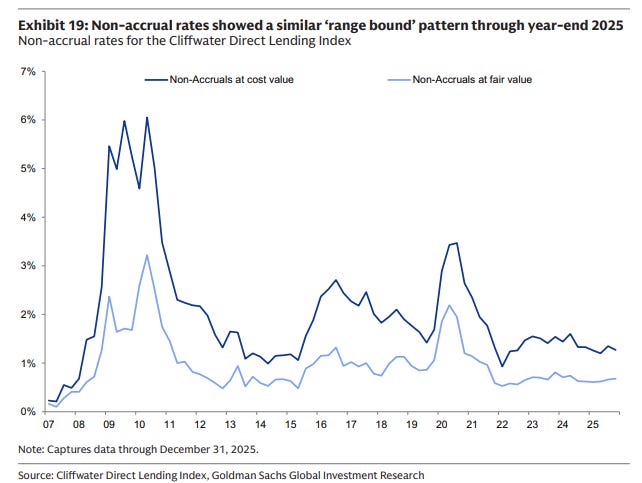
- Public BDCs versus private credit valuation gap: Off The Charts notes that publicly listed Business Development Companies are trading at a discount relative to private credit funds, which remain near full price. The author cites a 20% discount on private‑credit assets that historically delivered a 7% loss during the GFC, suggesting a built‑in margin of safety for public BDCs (GS/Cliffwater). With fundraising for private credit collapsing, the discount offers an attractive entry point for investors seeking exposure to the credit market without the liquidity constraints of private funds. Positioning toward public BDC equities could capture upside as the discount narrows, while avoiding the higher liquidity risk of private credit vehicles.
What to Watch
Key intraday catalysts include the release of U.S. CPI data (consensus 0.3% m/m) and the Fed’s Beige Book, which could confirm whether the energy shock is feeding core inflation. The 10‑year Treasury note at 4.36% remains a technical pivot; a break above 4.40% would reinforce the higher‑for‑longer narrative, while a drop below 4.30% could revive hopes of a rate pause. In the FX arena, EUR/USD at 1.1779 and GBP/USD at 1.3629 are testing resistance near 1.1800 and 1.3650 respectively; a breach could signal further dollar weakness. Asian equity indices, especially the Nikkei 225 at 62,834, will react sharply to any official statement from Tehran or the French president on Hormuz. The open question: will diplomatic signals this morning be enough to unwind the freight‑rate premium, or will the Strait of Hormuz remain a persistent inflationary drag?
