EU Midday Digest – 06 May 2026
AI-generated midday market digest from curated financial newsflow.
Brent crude slid to US$ 97.93 bbl, a 2‑4 % drop after the U.S. paused its Hormuz escort operation, reviving energy‑risk concerns.
Overnight & European Session
Asian markets closed higher on the back‑stop of a tentative U.S.–Iran memorandum, but Europe opened with equities in the green as the S&P 500 rose 0.81 % to 7,259 and the Euro Stoxx 600 jumped 3.14 % to 6,054. The euro appreciated to 1.1788 against the dollar (+0.82 %) while the dollar index slipped to 98 (‑0.80 %). U.S. Treasury yields diverged: the 2‑year slipped to 3.60 % (+0.28 bps) but the 10‑year fell to 4.42 % (‑0.67 bps) and the 30‑year to 4.98 % (‑0.82 bps). The VIX eased to 16.31 % (‑6.16 %). The move was driven by two opposing forces – a possible diplomatic de‑escalation that lifted risk‑off sentiment, and a still‑fragile Hormuz choke‑point that kept energy‑related equities under pressure, as highlighted by PiQ Suite and Zack Eiseman.
Key Themes Today
- Energy‑Risk Premium Collapse: PiQ Suite notes that Brent’s 2‑4 % pull‑back after the U.S. paused its Hormuz escort reflects a rapid shedding of the conflict‑risk premium, yet the underlying fragility of the Strait remains. Reuters reported a cargo vessel hit by a projectile and the HMM ship set ablaze, while Bloomberg cited a broader 4 % retreat in oil prices. The same de‑escalation is echoed by Zack Eiseman, who warns that the “shipping choke‑point” still supports tanker spreads and shipping stocks. The macro implication is a short‑term bearish bias for energy equities and inflation‑sensitive currencies, with a potential rapid re‑pricing if tensions flare. Positioning should stay short on oil‑linked assets while monitoring diplomatic moves for any durable de‑escalation.
- AI‑Hardware Broadening Rally: The AI chip boom is no longer a single‑stock story, according to PiQ Suite. AMD surged 12 % after hours on an earnings beat and raised outlook on sustained AI‑chip demand; Super Micro Computer forecast revenue above estimates, citing robust AI server infrastructure; Samsung’s market cap briefly topped US$ 1 trn on AI‑chip enthusiasm (Reuters/Bloomberg). This diversification suggests that exposure should shift from a Nvidia‑centric bet to a basket including AMD, Super Micro, and Samsung, as sector‑wide tailwinds support higher multiples and earnings growth. Investors can capture upside by adding these names while keeping an eye on supply‑chain constraints that could affect the broader semiconductor ecosystem.
- Credit‑Market Cross‑Asset Linkages: The convergence of tighter U.S. policy expectations and private‑credit stress creates a multi‑asset pressure point. Zack Eiseman reports that bond traders now price a Fed rate hike rather than a cut, which could strengthen the dollar and lift U.S. yields, dampening emerging‑market (EM) risk appetite despite any Middle‑East de‑escalation. Simultaneously, PiQ Suite flags growing bank exposure to private‑credit funds as a systemic credit‑risk tail, with Bloomberg noting Blue Owl’s potential $30 bn sale of its Asia platform. The combined effect is higher credit spreads on banks with private‑credit exposure and a need to reassess EM sovereign and corporate yields against a backdrop of a stronger dollar and elevated U.S. rates.
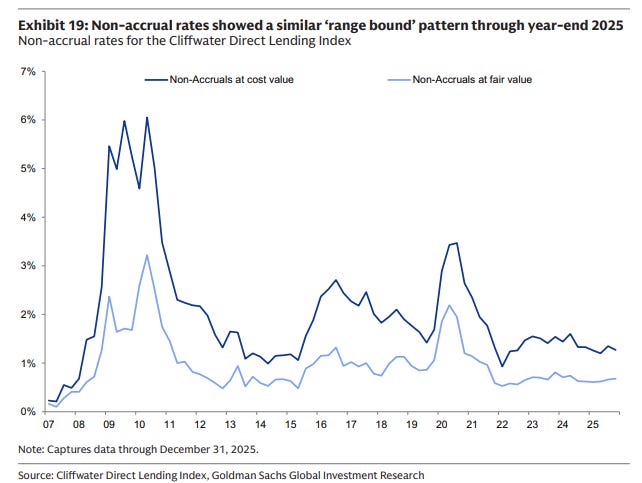
- Contrarian View on Private‑Credit vs. Public BDCs: Off The Charts argues that publicly listed Business Development Companies (BDCs) are now a relative‑value play versus private credit, citing Goldman Sachs’ view that private credit remains a small, low‑leverage slice of total debt. The author notes that public BDCs trade at a “significant” discount while private vehicles sit near full price, implying upside as the discount narrows. By contrast, PiQ Suite warns of a systemic credit‑risk tail from banks’ private‑credit exposures, suggesting heightened risk for the private side. The divergence highlights a tactical choice: tilt toward liquid, discounted public BDCs for price appreciation, but remain cautious of broader private‑credit stress that could spill over to banks and EM markets.
- UK Local Elections as Fiscal Barometer: PiQ Suite points to the May 6 UK local elections as an early gauge of fiscal policy direction, which could move the pound and gilt yields. Reuters notes that a modest right‑leaning swing could lift GBP/JPY and push UK gilt yields higher, while a Labour‑centric outcome would preserve a dovish bias. With the pound currently at 1.3641 against the dollar (+0.81 %) and UK gilt futures reacting to fiscal expectations, traders should position for a short‑term move in GBP and UK bonds based on the election result, using the outcome as a proxy for future fiscal stance ahead of the general election.
What to Watch
Key intraday catalysts include the release of U.S. CPI (consensus 0.3 % m/m) and the Fed’s June policy statement, which could confirm the market’s shift toward a rate hike. In Europe, the Bank of England’s monetary‑policy minutes (expected at 12:00 GMT) will be scrutinized for any hint of a tighter stance that could reinforce the pound’s move. On the corporate side, AMD’s post‑earnings guidance and Super Micro’s upcoming quarterly results will test the AI‑hardware rally. For credit markets, watch the 10‑year Treasury at the 4.42 % level; a break above 4.45 % would signal further tightening pressure on EM yields and could accelerate dollar strength. Finally, the outcome of the UK local elections will be decisive for GBP/JPY and gilt yields. The market’s most pressing question remains: will a concrete U.S.–Iran memorandum materialize today, fully stripping the oil risk premium, or will renewed tension in the Strait of Hormuz reignite energy‑related volatility?
